Showing posts with label 3D printing. Show all posts

Monday, October 19, 2015

Arches

I've been behind on updates since July and now I've got to try to catch up.

In addition to beginning work on the 5000, I also acquired new project. Back in October 2014, I purchased a set of Walthers North Shore ends on a whim. I had no plans for them and figured they might be useful down the road for trading or something. Later I was able to acquire a Walthers arched roof and mats. Again, purchased them only because they were available and decently inexpensive. (It should be obvious where this is going.) A few months ago I found a pair of Walthers “interurban sides” that were appropriate for a North Shore car. My new project is to assemble and complete this Walther’s North Shore kit. The car sides (specifically the window arrangement) put this car in the high 700s. I haven’t decided whether or not this car will be powered or even if it will be part of the Skokie Valley or Shore Line trains. It’s a low priority project; something for the backburner. In an email blast a while back, I saw a picture of a North Shore car built from a Walthers kit on the Salt Creek Lines. I’ve forgotten who built it, but it looked superb and betrayed nothing of its rather average beginnings. With the right amount of effort, I have high hopes that my planned car will look as good.

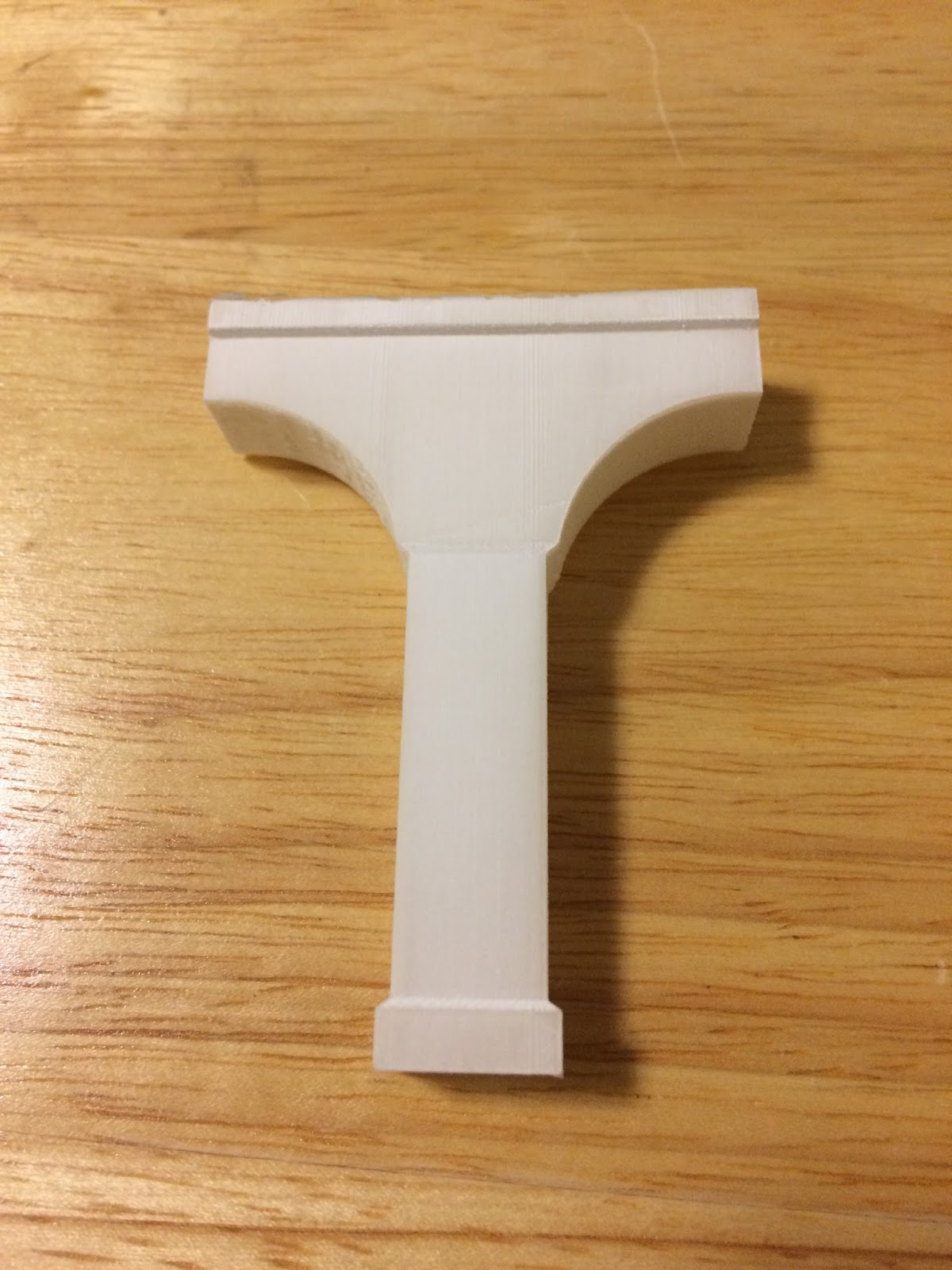
I've also done some 3D modeling. I went back and decided on a shape for the arches atop the support columns under the viaduct. I settled on useing a circle to create the curve of the arch although the shape of the actual arch is closer to a vertically squashed semicircle. The idea here is to make a mold of a 3D printed master since I’ll need fifteen middle columns and six end columns for the viaduct. I am yet to determine a method of actually doing this and I’ve also yet to select a material.

Circular arches. The green is simply a marker for how high the curb/sidewalks need to be and is not part of the model.

Once a suitable interior shape was developed to make the structure hollow (done to keep costs low[er]) I had it uploaded to Shapeways and printed. As soon as this went through, I suddenly realized a miraculously simple way of producing the "squashed semicircle" shape for the arches that I wanted. All that's required is drawing a circle and then rescaling it vertically, but not horizontally. The result is an oval.

"Squashed" arches. The difference is subtle, but the arches are a much closer match.

Meanwhile, the original design was printed and shipped out. The results were... less than optimal.

Looks okay so far.

Oh. That's not right.

Not sure where the surface stuff came from, but that should be easily sanded off.

It's difficult to see, but the piece is actually slightly curled.

I'm actually not too worried about it since the arches need to be redone anyway.

Friday, August 14, 2015

Pantographs and Trolley Beams

Strap in! It’s a long one.


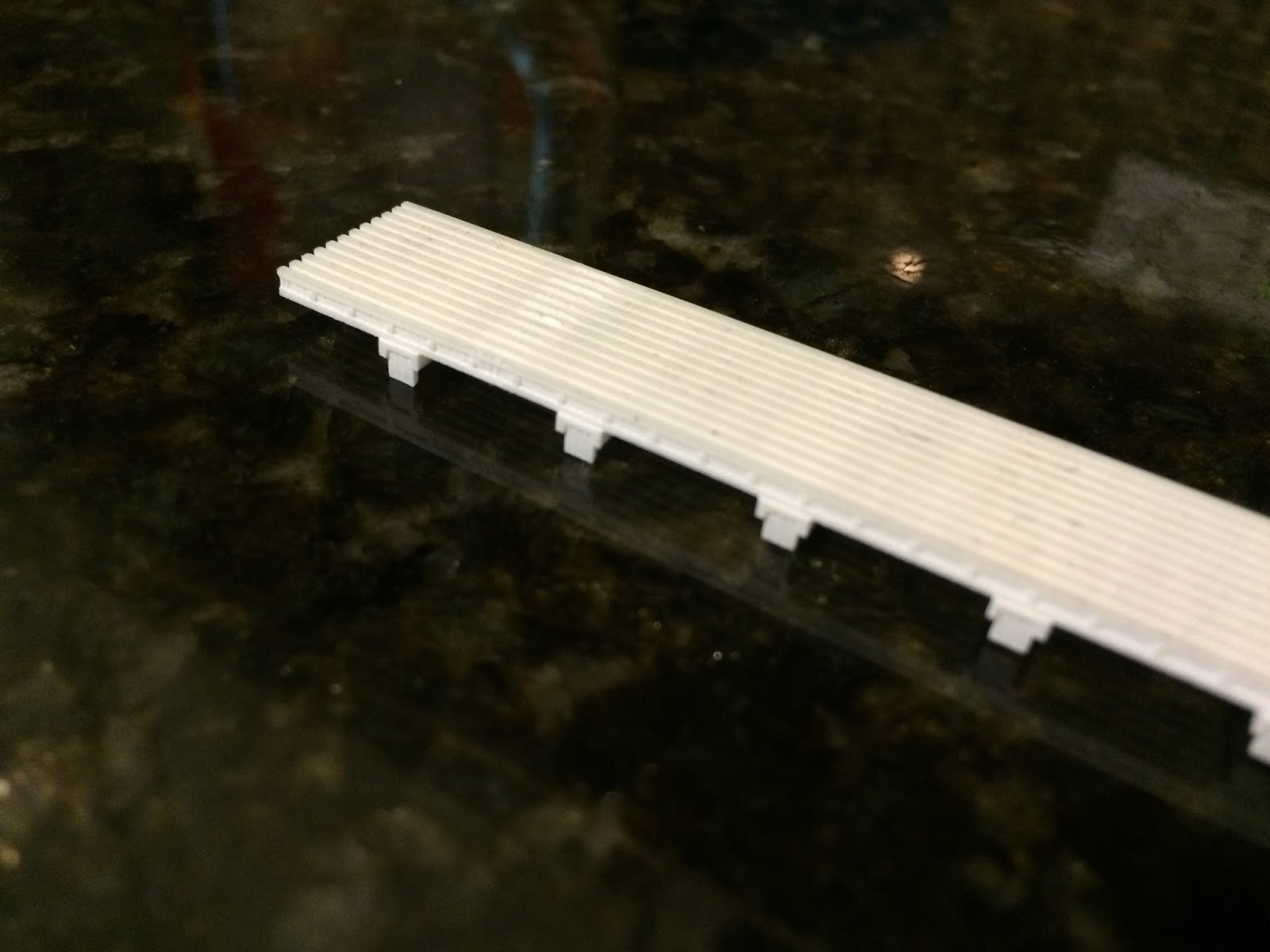
Since May I’ve made some headway on a number of projects. 3D modeling continues as always and on July 9, I received the first print of the experimental roof walks for the 3200 series cars. The walks in question are only the rear half, the portion that is only half-width. This was done as a cost saving measure for the test article.

The plan was to see how these came out and then work on and produce the front half which supported the pantograph. The two sections will line up and be glued together to form one complete piece. Instead of attempting to match the curve of the MTH roofs, I made the support brackets slightly longer than needed. Once glued together, I’ll place a piece of sandpaper on the roof and then gently rub the roof walks back and forth on top until they conform to the shape of the roof.

Unfortunately, after looking at the piece and being wholly satisfied with it, I began work on the forward portion only to discover that it would be visibly too wide for the car. To fix it, I needed to reduce the gaps between the horizontal members by 0.2mm each. Since the rear portion and the front portion have to line up, this meant that the rear portion needed to be narrowed as well, rendering the original one unusable.

I was able to make the rather tedious corrections relatively quickly and sent off for an updated version. Thankfully Shapeways was having a short term deal where shipping is free.

The narrowed rear portion of the roof walks arrived on the 16th and it definitely looks better than the original. The downside is that this was the first piece that I’ve gotten with some kind of a printing error. It arrived with a globule of “white stuff” which went across and between the slats in one section.

This didn’t come off while soaking in Bestine but did come off afterward after being cleaned with an old toothbrush under running water. Some of the slats were damaged (either in production or during cleaning—impossible to tell which) and from certain angles this shows. This end also has a strong odor of cherry syrup, which is highly unusual since 1) none of the other pieces have had this smell and 2) I can actually smell this with my barely functional nose! (The fact that I can smell it really attests to the strength of the smell.)

Otherwise, the piece came out well.

The damaged area is slightly visible from this angle. It is between the first and second supports on the left. In removing it, some of the top portion of the walk was damaged.

The original is at top. The newer one has been soaked in Bestine, giving a clear demonstration of what the agent does to Frosted Ultra Detail. Again, damage is visible here.

Tying in with the roof boards, my father and I took a trip out to the Illinois Railway Museum on Wednesday, July 8. While there, I was able to locate the pantographs from the 3200s and get some preliminary measurements. Now that I know where they are, I’ll be sure to acquire a very detailed set of measurements to be able to build the correct ones myself.

Progress has also been made on a new set of trolley beams for the same cars. I’m still working on perfecting the design of the third rail shoes themselves, but the equipment supporting the shoe has been designed and printed. This is a test to see how Frosted Ultra Detail handles separate-but-interlocking parts. (I would feel immensely satisfied if I could manage to produce dangling third rail shoes that could also glide on top of a rail.) If this fails, I can at least manufacture a set of trolley beams for the 3200s that don’t have provision for sleet scrapers on the rear trucks, as is prototypical.

The test piece also arrived on the same day as the narrowed roof walks. The two loops which hang down and connect to the third rail shoe do dangle, but not as freely as I’d hoped. Soaking them in a bath of Bestine did help, as did working them a bit, but they still don’t swing completely freely. I’m hoping there’s some kind of lubricant I can try to make them work better. I’d rather not resize the parts to improve “functionality” as areas on this piece are already pushing the limits of Frosted Ultra Detail in terms of minimum width and also because this would alter the look of the piece.

Perhaps it’ll work better once the shoe itself is added. Fingers crossed.

I actually printed this piece in Frosted Extreme Detail (which is the same material as FUD, but printed with thinner layers). The difference in cost for such a small piece ended up being 10¢ and I figured a dime was worth the expense of finding out what the big deal was.

Ultimately I don’t see too much of a difference and it certainly doesn’t seem to be worth the extra cost for larger pieces.


Additionally, I purchased a pair of Japanese pantographs from the East Gary Car Company. These pans are supposed to be junk, but as it’s the shoes I’m interested in, that doesn’t matter. I am fortunate enough to know someone who has a small, but overfilled workshop. He had a spare rotary tool (Ryobi, not Dremmel) that he didn’t want taking up space and he gave it to me. (One tool down that I don’t have to purchase!) Using this, I have already cut apart the shoes on one of the pans. (So far no complaints about the Ryobi.) These shoes (of which there will be four in total) will be for the 1-50 and 5000 series trolley pans. I still need to gather more information on the trolley pans before continuing much further down this road.

One of the big things holding me back on the 1-50 (car 2) and the 5000 (car 52) is my lack of a soldering iron. I’ll need this not only for the construction of the trolley pans, but also to remove the existing roof boards on both cars. I’m already stretching money a bit so this isn’t something I’ll be purchasing in the immediate future.

A tase of things to come

Still, progress continues. The middle section of car 52 doesn’t (and never did) have roof boards since there never was any trolley equipment located there. This makes the middle section an ideal place to start. I’ll prime this section as soon as possible.

The wheels on the 52 are another issue. As built, the 5000 series cars were equipped with resilient wheels. By the time the cars were assigned to the Skokie Swift and rebuilt, these wheels had been replaced with standard equipment.

The trucks supplied with the car are correct in appearance (they’re actually a fair sight better than the CTA 6000/1-50 Clark B3 trucks from Q Car) so I’ll be keeping these and replacing the resilient wheels currently on the model with “regular” 26” flush wheels from NorthWest Short Line. I haven’t decided on what to do with the power trucks yet. (I’m not even sure that the wheels are insulated. I have a strong doubt that they are.)

Wednesday, May 13, 2015

Step right up

The steps arrived from Shapweays a few days ago and (in spite of my initial misgivings) I’m completely satisfied with the results. They don’t look bulky at all and should look very good once applied to the cars.

The one downside to the 3D printing process at Shapeways is that they don’t give the designer control over the print orientation. This is of vital importance to the final product as the print orientation determines which face will ultimately show the layers of the printing process. With control over this, a designer could specify a particular face to be “up” or “down” in the process and thus eliminate printing lines on surfaces that are intended to be seen.

Unfortunately, Shapeways will not relinquish this control to individual designers as they print orders on a tray en masse and each part on that tray is supposedly oriented in a position to optimize use of the wax support material for production. (This waxy support material is the substance that’s usually stuck to parts once they come from the printer.)

I’m not sure how this was “optimized” for the steps as they seem to have been printed on a diagonal. (Picture a cube balancing on one edge instead of sitting on a side.) This has left some very small (but still visible) jagged edges that I will have to very carefully sand smooth. This was my fourth printed piece and so far none of them have returned with any visible amounts of residual wax (this may be due in part to the fact that all of my pieces to date have been rather small) but I went through the process of wax removal anyway just to be safe for priming and painting.

The tried and true method for dewaxing Frosted Ultra Detail is to soak the part in a bath of Bestine. Bestine is a solvent and thinner for rubber cement. It can be purchased online or at art supply stores. In the Chicago area both Blick’s and Utrecht carry it. I used an old glass jar to facilitate the process.

How they appeared prior to wax removal. (It was exceptionally difficult to get these even remotely in focus.)

The imaginary minced garlic in this container contains chemicals known to the state of California to cause cancer.

I submerged the set in the Bestine for ten minutes before returning the solvent back to its container. Visibly there was no outward change that any wax had been removed, but the surfaces of the piece had turned white. This is normal for the chemical wax removal process.

Some of the jagged edges can be seen here.

After setting the piece on a paper towel to dry, I carefully separated each set of steps from the sprues. In order to save on cost, I went the minimal approach and spaced each piece very closely to keep the amount of material used as low as possible. The downside to this was that in some cases there wasn’t much space available to cut. Fortunately they all separated cleanly. The part that really had me worried was cutting the remaining sprue pieces off since the ladders are angled and in many cases could not be put on their flat sides to make the necessary cuts. Frosted Ultra Detail, it turns out, is flexible enough and strong enough. Even when printed at its minimums, each part took the cuts with no damage. This was followed by a bit of light sanding with 800 grit sand paper and they were ready to prime.

After separation, but before sprue removal.

Since ventilation in my house isn’t generally good (and by “generally” I mean ever) and since I have several small birds that would be extremely susceptible to fumes, all of this has to be done outside. This also means that work is dependent on the weather. I liberated a cardboard box from my job to serve as a hood. Because these pieces are so small and light, a gentle zephyr could take them away. To solve this they’ll be stuck to loops of tape which will be taped to the back of the box. Once the weather cooperates they’ll be primed.

No, not this kind of Zephyr.

Since Memorial Day is coming up, my family and I will be taking a trek out to the Illinois Railway Museum and I’ll finally be able to get the remaining measurements I need for the 2200 series and hopefully I’ll have time to take a crack at the 2400 series. (With my luck they’ll both be in operation and I won’t get at them.) I do have a new “secret” project that this visit may certainly help. Keep an eye out for it!

Tuesday, March 31, 2015

March in Review

Let’s get straight to the point; I spent a lot of money this month. Even though I’d planned on spending a good deal of money on models this month, my actual total greatly exceeds my anticipation (and this doesn’t even cover routine things like food and bills). I had a number of other projects (not model related) that also cost more than expected, so April will almost certainly be a very quiet month around here.

With that said, it seems like a good time to stop and reflect on a very expensive (but good) month. March is the month of the Chicago O Scale Meet (also known as the March Meet) and associated open houses at various trolley layouts. Preparation for these two prompted me to get back in gear and begin working on the 3D model of CTA’s form 5 coupler.

Ultimately this design wasn’t finalized in time for the open houses (I was only able to attend one) and the design work is still ongoing. The continuation of this project should be a nice one to carry on into April.

Before the meet I was able to get my hands on a Clouser North Shore steel coach. Although it did not come with trucks, I did get a good deal on it and am very happy with my purchase. The following week was the March Meet and there I bought a brass North Shore 170-182 series coach. Acquisition of this car has enabled me to outline and define my projects for the North Shore Line. I’d already decided on modeling the North Shore circa 1952/1953 (the same years for the CA&E) and the addition of these two older steel cars has led me to separate my efforts into the creation of two trains: Chicago-Milwaukee via Skokie Valley (the combine and upper 700) and a Chicago-Waukegan Shore Line train (the “older” coaches).

I have already ordered a motor truck set that would be applicable to either car on the Skokie Valley train, so I’m waiting for that to arrive. I’ll have to construct a test track pretty soon, which I suppose will be the very beginnings of my layout.

Also at the O Scale Meet I bought a pair of pantographs to turn into sausage. The shoes on these will be cut apart, to produce four “single” pantograph shoes. Each of these will be mounted at the end of a pair of four-spring horizontal trolley poles. I still need to buy a total of eight trolley poles for car 2 (the 1-50) and car 52 (the 5000) to make this. As a result of... overspending... I probably won’t begin this phase of that project in April.

After the March Meet I went back and made complete 3D models of the 3200-series snowplows. After increasing the size of the nuts so that they would register at Shapeways, these were sent off to the printer. They arrived on Monday and I am extremely pleased with the results. I’ve already made these available via the Ravenston Car Company at Shapeways. (Shameless self promotion!)

In continuing work on the 3200s, I ordered a set of wheels from NorthWest Short Line. I had planned on mounting these inside of cheap, temporary trucks (shop trucks) but I’ve abandoned this idea in favor of 3D printing my own set of “test trucks” which will enable me to try a few things out and see how well this will actually work. Unfortunately, 30” wheels are on backorder for about a month, so this particular project will probably have to wait for a while. In the meantime I’ll see if I can gather some pictures of the Duewag trucks with which the cars are equipped.

I know someone who claims (strong emphasis on “claims”) that he has access to equipment to make metal casts and, if all goes well, I should be able to make molds of the 3D prints and produce a series of metal trucks.

Even after the end of the March Meet March continued to be a money spender! I found another brass 1-50 series car and didn’t hesitate to grab it. To model the four basic iterations of Skokie Swift equipment as planned, I need a total of three of these cars: one as for a single-unit 1-50 and two for a double-unit 60. I now have two.

My first 1-50 has a dent on one end which I should be able to hammer and fill back into shape. Regardless of how well this turns out, the original (dented) 1-50 will now be used as part of the 60 pair with the dented face being positioned between the cars to minimize its visibility. The new car will now be the single and will get the CTA designed trolley-pans.

I also started work on a 3D model of the resistor grids for the 3200 series. This model uses measurements taken from the pair of 2400-series cars at the Illinois Railway Museum. There are subtle differences between the 2400 and 3200-series equipment that I have to account for and I’m currently working with the design to get it right.

The benefit of creating this model in full scale and then reducing it is that it can effectively be used to create specific models for the 2400, 2600, and 3200-series cars with only minor variations in each and scaled appropriately to 1:45 for the 3200s and to 1:48 for my planned 2400s and 2600s.

The 2200-series cars (which I have already started designing) used a resistor set that was substantially different than those used on the later cars. During my last trip out to IRM, I didn’t take underbody measurements for the 2200s, so I won’t be able to continue work on that particular set until I make another trip out to Union.

Finally (my wallet has its fingers crossed that this really is finally) I found a power truck set that would be appropriate for either car in the Skokie Valley train. It matches the truck I ordered from NorthWest Short Line, although at present I don’t know if the motors are Magic Carpet IIs or IIIs. The main impetus for getting this truck was the fact that I was able to get it for a substantially lower price than normal.

Moving forward into April my projects are most likely going to be all 3D modeling as this can be done at no cost. I plan to finish the form 5 coupler, work out the kinks with the resistors, and begin creation of an underbody set for a 2400-series pair (since I have photos and measurements on hand for that). I’ll also be continuing to fabricate the replacement car floor for the second 3200-series car.

Friday, December 26, 2014

Erroneous Values!

So, after pulling my hair out trying to find this separate piece, I gave up and decided to reduce the thickness of the "finished floor" by 1mm just to see how much money this would knock off the total price. It turns out 1mm translates out to about an $18 savings. More importantly, though, the product no longer registered as having "thin walls" or multiple parts! The loose piece didn't exist (thank goodness) and, as designed, all of the walls were reading as having acceptable dimensions. The problem was just some mathematical artifact in the file's coding picked up from somewhere. The new, thinner, file didn't have such errors. Success!

But wait. Not so fast. I knocked off a few more millimeters here and there (things I decided weren't essential and probably wouldn't actually help much) just to see how much more I could get the price to drop, uploaded the new file to Shapeways, and suddenly two of my old friends reappeared. Now knowing what to look for, I was able to find them much more quickly. For some reason, part of one of the seats was not registering and this was causing the stanchion connected to that seat to be attached to nothing. (This is where the multiple parts issue came from.) The other problem, it turns out, is being caused by a shape emanating from one of the windbreaks. This shape is too thin for the printing constraints.

Here's the kicker: none of these issues are representative of the 3D model I've created. I can't just fix them on my end, because they're non-existent. This means that there's either an error in the exporting process from Google Sketchup's native file format (.skp) to Collada (.dae) which is one of the acceptable file types for Shapeways, or the problem is with Shapeways and they way their computers are reading such files.

Either way, I have no solution at present.

Sunday, September 21, 2014

Success on Two Fronts

Okay, so this update is long overdue. In the intervening weeks I have had some successes with my models and my "layout." I have come to the decision (largely in part because of the purchase of the 2000-series cars) that the Dunsel Line will not be a traditional trolley layout. It will be a two-rail layout equipped with dummy third rail. This will allow operation of CA&E, North Shore, and "L" equipment even if the cars (such as the 2000s) are not equipped with trolley poles or pantographs. This will necessitate the pole- or pan-equipped cars to built to accommodate two modes of running, as they should be. This does come with a downside.

Prototypical placement of the third rail on the "L" has the top of the third rail 6½ inches above the top of the running rail and 20-1/8 inches from the inside edge of the running rail to the center line of the third rail. Contact with the third rail is made by a metal shoe (or a paddle in the case of very early AE&C cars). Contact with the third rail is made by gravity: the shoe naturally hangs and then glides across the surface of the rail when present. The problem here is that most on models, the shoe has been made in the free hanging or "down" position. This is fine for trolley operation as when under wire, the shoes should hang freely. With prototypical third rail placement, the shoe now hangs too low for operation. The MTH "L" cars have the shoe in the up or "on rail" position. This works well for prototypical placement unless the third rail is on the non visible side of the model or at gaps. In these situations the shoe isn't hanging when it should be.

A trolley beam on a St. Petersburg 2000-series car. The shoe is depicted as hanging free. This would collide with a prototypically placed third rail.

MTH made the shoe in the "on rail" position.

There are three ways to work this problem. The first is to use the commercially available trolley beams in the free hanging position and adapt the height of the third rail accordingly. The other is to use the on rail position and place the third rail according to where it will be seen by the viewer. I'm not entirely satisfied by either of these options.

The third option is, if at all possible, is to create a trolley beam with a third rail shoe that functions like the prototype so that it can glide or dangle as need be. I'm a neurotic freak so this sounds extremely satisfying. I had this idea in the past, but dismissed it due to my inability to construct such a small thing effectively. But now I can have things 3D printed! And according to the specifications on Shapeways' site, many materials do allow for moving parts if proper clearance is built into the design. Looks like I've got a new project...

Granted, this won't take into account the placement in the third rail given the difference in scales (1/48 vs. the 1/45 for the MTH cars) but I'll just have to live with it.

This actually leads to the first of my successes. The prototype seat for the 3200-series cars arrived from Shapeways on Monday and I’m pleased with the results.

This took far longer than I’d expected and was also fraught with no small amount of frustration. The first problem was getting the angle of the seat back to my own satisfaction (picture a weirdo riding the Ravenswood messing around with perfectly normal seats with a protractor and a crude, improvised plumb bob). The next (and far more frustrating) bit was to create the handhold on the back of the seat.

I was very much relieved to discover that the handholds on the 3200s are much simpler than their counterparts on the 22-, 24-, and 2600-series cars. Until I tried to produce them, that is. The process involves making an appropriately sized circle which will be the “pipe” in question and then drawing a curved line representing the path of the pipe. In this case, the path went up from the circle, curved to one side, continued horizontally, and then curved down to the same height at which it started. Once that path is created and placed on the appropriate plane (another interesting quest in of itself) and positioned with the start at the center of the circle, the “follow me tool” is used to extrude the circle along the specified path. Simple. Or not, as I kept getting error messages that people in Youtube videos never seemed to get.

Once I realized that the problem was that some combination of Google Sketchup and my computer was being a lazy pile of rancid horse turds, the project moved along swiftly. (No Skokie pun intended.) My problem was that I was trying to create the curve in 1/45 scale. This was simply too small for the program to handle. It wouldn’t do the math. However, once I scaled up the curve/circle combination to a large enough size, I was blessed with numerous beautiful curved pipe segments. Armed with this, I used the scale tool to reduce the piece to the appropriate size, and voila! (Apparently Sketchup has no problem rendering such a small thing, it just doesn’t want to draw it.)

Once that hurdle was cleared, I saved my file, exported it as a .dae (which is a file type native to Sketchup 8 and can be read by Shapeways) and sent the .dae off to be printed. And like that, it was done.

The question I keep getting asked when I’ve shown this thing around is, why did you only make one? I wanted to produce one seat just to determine what the end product would look like on a simple design and then rework my design from there. A single transverse seat seemed like the best option. This was printed in “Frosted Ultra Detail.” There are other (cheaper) alternatives available, however none of the other materials were sufficient to produce the detail included and wouldn’t pass some of the initial checks.

There was a slight (and I do mean slight) problem in the printing process. I didn’t include the stanchion that connects to the handhold on the back of the seat, but I did include the connection for it. This is the little nodule in the corner. This is an object that is shaped almost like an inverted, blunted, ogive cone. It is quite diminutive, but still bigger in diameter than the bar itself. The problem is that it didn’t print fully. There’s a “gap” in the back. Fortunately, it is so tiny that it isn’t very noticeable.

Now that I’ve seen what it looks like, I can say I like it and I can go ahead and make up the other variants. (Assuming I don’t go back and try to add the curves to the seat back and “cushion.”)

This still leaves the problem of the stanchions themselves. Still haven’t figured that one out just yet.

The second success is that the Dunsel Line has acquired a new piece of rolling stock! I am still waiting for it to arrive, but it is a high numbered 700 North Shore Line car in brass. (My knowledge of the North Shore isn’t what it should be, so I can’t identify the specific series until I consult my father’s CERA bulletins.)

This is my first North Shore model. The model didn’t come with trucks, trolley poles, or even a box. (This is why I it wasn’t identified when I purchased it.) What it does have is a few dents on the roof and some tarnish in a few spots, but these things should be easily fixed.

The plan here is to paint it in the final variant of the North Shore’s green and red and equip it with appropriate Q Car Company trucks insulated for two rail operation. Power will be supplied by a pair of NWSL Magic Carpets. A selector switch will, of course, have to be installed for two rail or trolley power. Poles will also be Q Car.

Exciting times ahead!