Showing posts with label 3200-series. Show all posts

Friday, March 24, 2017

2016 in Review

“The reports of the Dunsel Line’s demise are greatly exaggerated.”

While it started off rather well, 2016 was ultimately not a great year for modeling for me. Contrary to what the lack of updates may suggest, there has been progress over the past year. Some projects have inched forward, while others have not. What follows is a smattering of what has been accomplished since March 2016.

CTA 52 (Skokie Swift)

The underbodies of all three sections have been primed, leaving the bodies of the A and A1 sections of the car in their natural state. A resistance soldering unit was acquired from the defunct Chicago & Utopia shops and made short work of the trolley shrouds and brass roofboards. (I left the boards on one section for the time being as a reference point.)

Very recently, I ordered the Chopper III from NWSL and made short work of a set of styrene strips that will become the new roofboards. It is a very nice little tool that I expect to put to good use. I still have to get the dimensions of the “saddles” (the supports for the boards) and fabricate them before I can continue.

The PCC cars that were “Skokie equipped” were given sets of curved horns that I had long searched for as a commercially available product. This search was in vain. The 5000-series cars carried these horns on the roof near the destination/route sign meaning that they were generally out of reach. On a trip to the Illinois Railway Museum, however, I discovered that an accessible pair of 6000-series cars was equipped with these as well and that the horns were beneath the anticlimbers. Not long after returning with pen, paper, a tape measure, and a few other odds and ends, I had a set of 3D printed horns arriving at my office.

CTA 3200s (Skokie Swift)

After the last printing of the front section resulted in a less-than-optimal print (and also turned out that I’d made a mistake and made the piece too short) I have gone back and decided to redesign the whole thing (front and back). The rear portion looked good, however the brackets that support it didn’t fit into the grooves on the roof. This was something I had never intended and just figured I’d work around it, but with the needed redesign of the front, I figured why not correct this too? In all, it required an increase in width of 1mm. The difference is small enough that it shouldn’t be visually noticeable, but should prove to make the fit much better and easier.

After printing and priming a partition with closed cab door, I discovered that pipe filters would make an excellent filler for the cab door window. (The small window in the door has a crosshatch in it.)

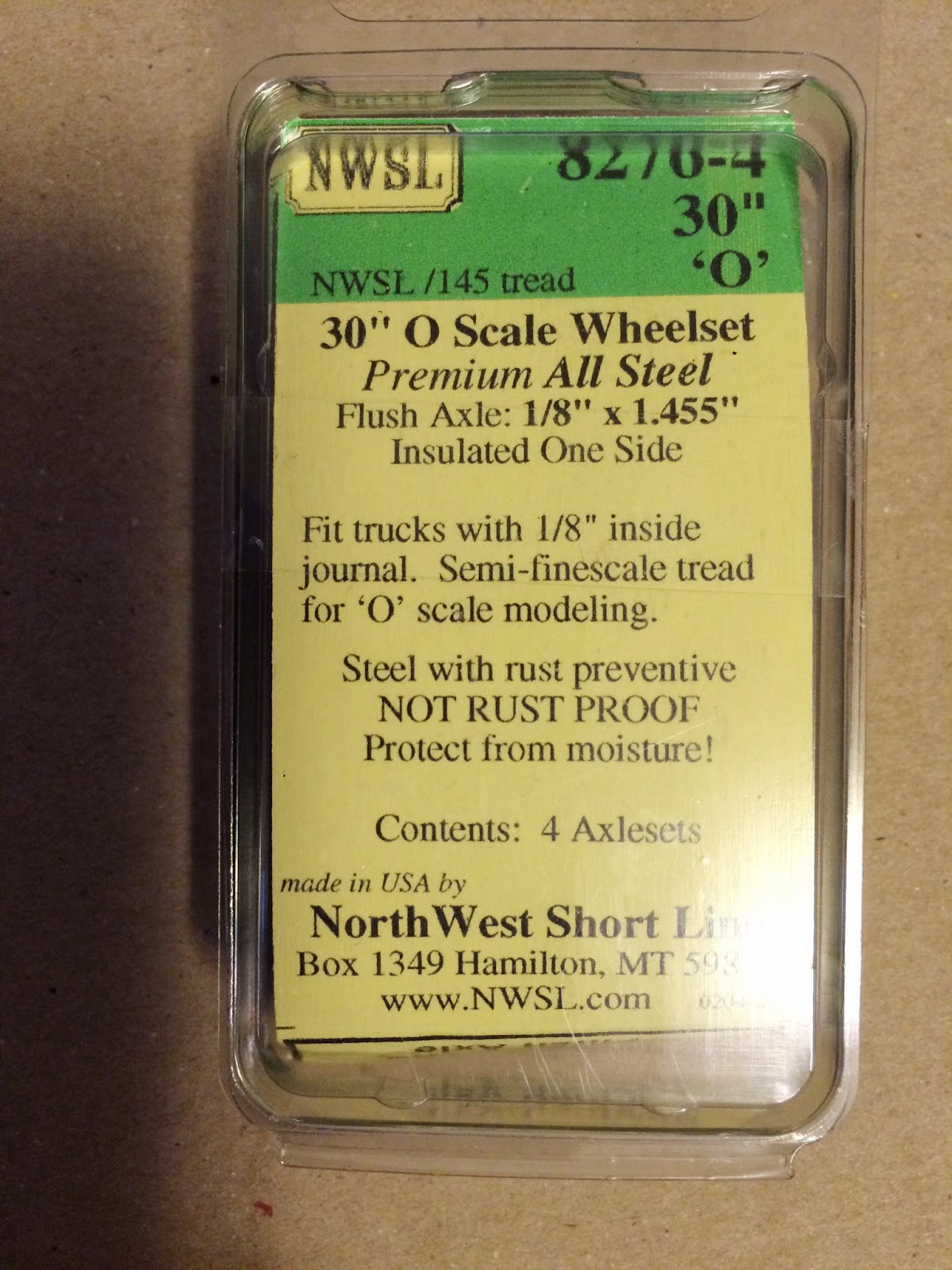
Another advancement came with the announcement that NWSL had finally come out with the Stanton drive in O scale. The downside was that the wheelbases offered (8’-0”, 8’-6”, and 9’-0”) were too long for most traction applications, but after emailing them, I was informed that S scale drives were available that were capable of accepting O scale wheel sets and that the wheelbases offered (same as for O scale) would scale out appropriately for O scale traction applications. I promptly ordered a pair of these with a 9’ wheelbase with 30”/145 flush axle wheels. For the 1:45.2 size of the car, the trucks are slightly too short and the wheels are slightly too large, but this is by far close enough and well worth the avoidance of the headache of building my own. When complete, each car will have the rear truck powered so that the ends can have visually appropriate trailer trucks.

CNS&M 170 series cars (Shore Line train)

I make no attempt to hide the fact that I am a novice modeler from others or (more importantly) myself. Given that I recognized the simplicity of some of the North Shore cars and decided to put some effort on these.

Unlike the CA&E, there are no multiple unit connections needed for proper trolley operation and trailer cars only need power for interior lighting. With the completeness of the brass models, this reduces the project (for the most part) to painting and wiring (and the wiring will be simple due to its minimal nature). This made it a great starting point. I began priming one of the two models before remembering that the trolley hooks need to be removed and insulated for proper operation. The trolley hooks on these consist of a bent wire that runs through the boards and into the roof where it is secured in place. Unfortunately it was not secured with a bead of solder so it could not be removed by heating the area and pulling without damaging the hook. Instead it needed to be removed, which was done with a Dremel. (I’m short on parts for this, so this is as far as I’ve gotten.)

3D Printing

It came to my attention that Bestine, the solvent used to remove the waxy leftovers from the 3D printing process is no longer made. I didn’t hear about this in time to stockpile it before it was all gone. The search for a pure heptapane replacement is ongoing.

Layout

There has also been decent progress on the benchwork, which is almost complete. All that remains at this point is installation of the legs, shelf brackets, and the two storage shelves. (Sufficient funds and access to the proper tools are the two things holding this back at the moment.)

The section under construction is going to feature the North Side Main Line embankment as it passes through Edgewater. This is a four track structure with island stations. I toyed with the idea of throwing in some crossovers, but decided to leave it at four straight tracks and I’ve acquired the track and subroadbed for this.

I’ll endeavor to put forth more effort in both modeling and maintaining this blog in 2017!

Friday, August 14, 2015

Pantographs and Trolley Beams

Strap in! It’s a long one.


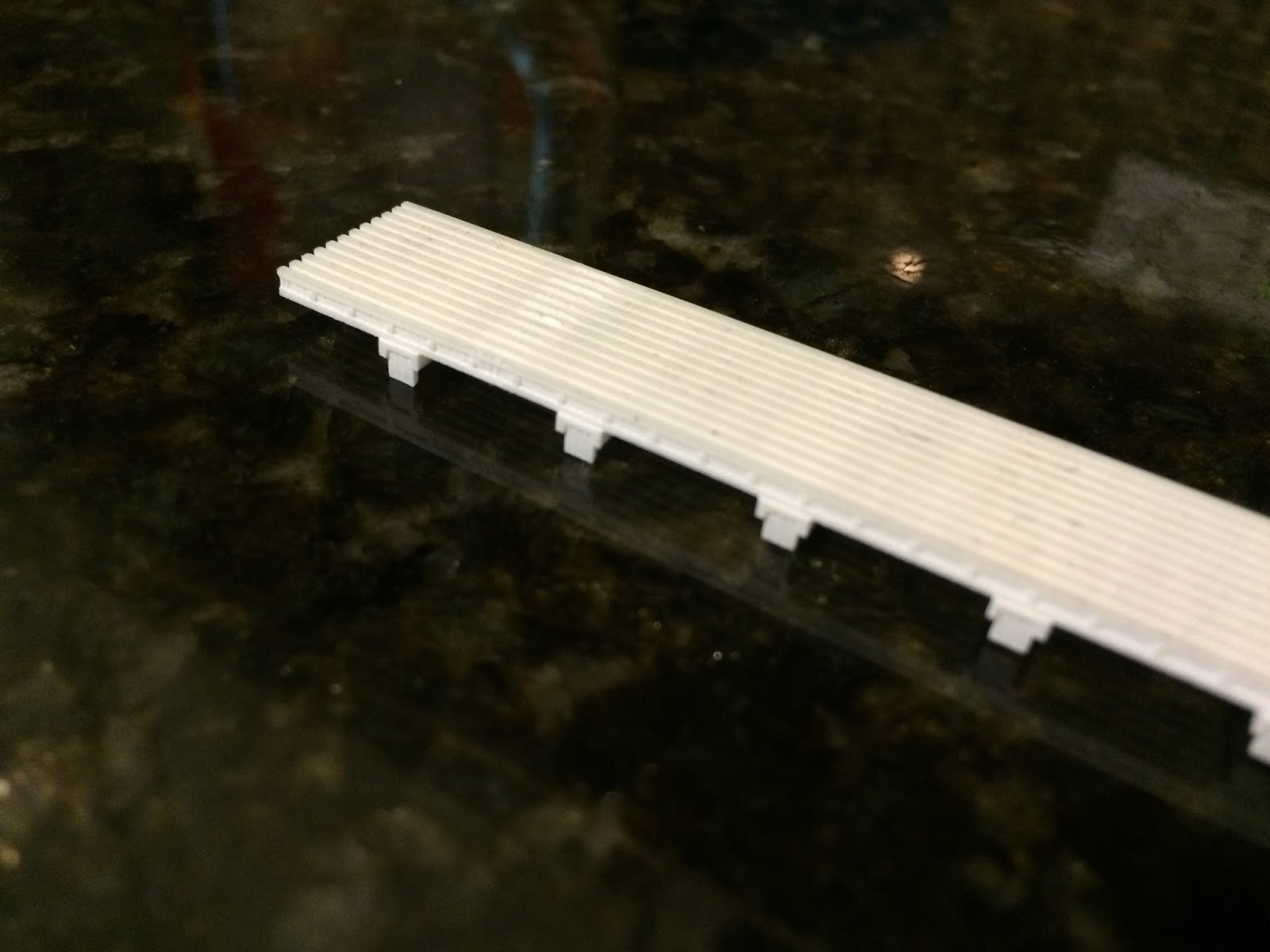
Since May I’ve made some headway on a number of projects. 3D modeling continues as always and on July 9, I received the first print of the experimental roof walks for the 3200 series cars. The walks in question are only the rear half, the portion that is only half-width. This was done as a cost saving measure for the test article.

The plan was to see how these came out and then work on and produce the front half which supported the pantograph. The two sections will line up and be glued together to form one complete piece. Instead of attempting to match the curve of the MTH roofs, I made the support brackets slightly longer than needed. Once glued together, I’ll place a piece of sandpaper on the roof and then gently rub the roof walks back and forth on top until they conform to the shape of the roof.

Unfortunately, after looking at the piece and being wholly satisfied with it, I began work on the forward portion only to discover that it would be visibly too wide for the car. To fix it, I needed to reduce the gaps between the horizontal members by 0.2mm each. Since the rear portion and the front portion have to line up, this meant that the rear portion needed to be narrowed as well, rendering the original one unusable.

I was able to make the rather tedious corrections relatively quickly and sent off for an updated version. Thankfully Shapeways was having a short term deal where shipping is free.

The narrowed rear portion of the roof walks arrived on the 16th and it definitely looks better than the original. The downside is that this was the first piece that I’ve gotten with some kind of a printing error. It arrived with a globule of “white stuff” which went across and between the slats in one section.

This didn’t come off while soaking in Bestine but did come off afterward after being cleaned with an old toothbrush under running water. Some of the slats were damaged (either in production or during cleaning—impossible to tell which) and from certain angles this shows. This end also has a strong odor of cherry syrup, which is highly unusual since 1) none of the other pieces have had this smell and 2) I can actually smell this with my barely functional nose! (The fact that I can smell it really attests to the strength of the smell.)

Otherwise, the piece came out well.

The damaged area is slightly visible from this angle. It is between the first and second supports on the left. In removing it, some of the top portion of the walk was damaged.

The original is at top. The newer one has been soaked in Bestine, giving a clear demonstration of what the agent does to Frosted Ultra Detail. Again, damage is visible here.

Tying in with the roof boards, my father and I took a trip out to the Illinois Railway Museum on Wednesday, July 8. While there, I was able to locate the pantographs from the 3200s and get some preliminary measurements. Now that I know where they are, I’ll be sure to acquire a very detailed set of measurements to be able to build the correct ones myself.

Progress has also been made on a new set of trolley beams for the same cars. I’m still working on perfecting the design of the third rail shoes themselves, but the equipment supporting the shoe has been designed and printed. This is a test to see how Frosted Ultra Detail handles separate-but-interlocking parts. (I would feel immensely satisfied if I could manage to produce dangling third rail shoes that could also glide on top of a rail.) If this fails, I can at least manufacture a set of trolley beams for the 3200s that don’t have provision for sleet scrapers on the rear trucks, as is prototypical.

The test piece also arrived on the same day as the narrowed roof walks. The two loops which hang down and connect to the third rail shoe do dangle, but not as freely as I’d hoped. Soaking them in a bath of Bestine did help, as did working them a bit, but they still don’t swing completely freely. I’m hoping there’s some kind of lubricant I can try to make them work better. I’d rather not resize the parts to improve “functionality” as areas on this piece are already pushing the limits of Frosted Ultra Detail in terms of minimum width and also because this would alter the look of the piece.

Perhaps it’ll work better once the shoe itself is added. Fingers crossed.

I actually printed this piece in Frosted Extreme Detail (which is the same material as FUD, but printed with thinner layers). The difference in cost for such a small piece ended up being 10¢ and I figured a dime was worth the expense of finding out what the big deal was.

Ultimately I don’t see too much of a difference and it certainly doesn’t seem to be worth the extra cost for larger pieces.


Additionally, I purchased a pair of Japanese pantographs from the East Gary Car Company. These pans are supposed to be junk, but as it’s the shoes I’m interested in, that doesn’t matter. I am fortunate enough to know someone who has a small, but overfilled workshop. He had a spare rotary tool (Ryobi, not Dremmel) that he didn’t want taking up space and he gave it to me. (One tool down that I don’t have to purchase!) Using this, I have already cut apart the shoes on one of the pans. (So far no complaints about the Ryobi.) These shoes (of which there will be four in total) will be for the 1-50 and 5000 series trolley pans. I still need to gather more information on the trolley pans before continuing much further down this road.

One of the big things holding me back on the 1-50 (car 2) and the 5000 (car 52) is my lack of a soldering iron. I’ll need this not only for the construction of the trolley pans, but also to remove the existing roof boards on both cars. I’m already stretching money a bit so this isn’t something I’ll be purchasing in the immediate future.

A tase of things to come

Still, progress continues. The middle section of car 52 doesn’t (and never did) have roof boards since there never was any trolley equipment located there. This makes the middle section an ideal place to start. I’ll prime this section as soon as possible.

The wheels on the 52 are another issue. As built, the 5000 series cars were equipped with resilient wheels. By the time the cars were assigned to the Skokie Swift and rebuilt, these wheels had been replaced with standard equipment.

The trucks supplied with the car are correct in appearance (they’re actually a fair sight better than the CTA 6000/1-50 Clark B3 trucks from Q Car) so I’ll be keeping these and replacing the resilient wheels currently on the model with “regular” 26” flush wheels from NorthWest Short Line. I haven’t decided on what to do with the power trucks yet. (I’m not even sure that the wheels are insulated. I have a strong doubt that they are.)

Thursday, May 7, 2015

April on the Dunsel Line

As predicted, April was a slow one on the Dunsel Line. There were no new purchases even though some were available. A pair of CA&E 450s was out there, but I passed these up. It’s just as well. I’ve already got two North Shore trains to work on in addition to the Skokie Swift pieces. Makes sense to at least try to finish some of this stuff, right?

As planned, I went ahead with more 3D modeling projects for the 3200 series cars. Unfortunately the Form 5 coupler is still not complete. My own attention to detail is really getting the better of me here. At this point I’m primarily stuck on one specific section of this model and lately I haven’t wanted to think about it so I’ve been avoiding it. (Not exactly an attitude that’s conducive for getting things done.)

Another project which I have been modeling is the steps for the 3200s. For whatever reason, when MTH made these cars, they didn’t include the steps. I suppose this stemmed from the same issue with getting the underbody equipment totally wrong. (Thankfully, when they produced the 6200 series, they fixed both of those issues.)

This is actually been a project that I’ve been working on since my last trip to IRM. For such a simple model I’ve really spent far too much time reworking things to get them right. Early on I kept getting holes in the model that refused to be patched and I hadn’t yet discovered the “intersect with selection” method which is necessary for making the angled portions of the side steps.

This method involves drawing a shape (in this case it was a rectangle) shifted to the appropriate angle and then moved to intersect the part of the model that needed to be “cut” at an angle. Once in place, both parts (the shape and the model) were selected and right clicked. This brings up a menu from which intersect is an option. It has two suboptions: “intersect with model” and “intersect with selection.” Intersection basically finds all the points of intersection between the two pieces and draws definitive lines at these points and incorporates them. From here the rest is easy; all that’s left is deleting all the unnecessary parts.

I wasn’t satisfied with how they looked on my computer in Sketchup or in the Shapeways render. They looked too thick to be right. I had to remind myself that the sides came out to be 0.6mm thick, the smallest workable size in Frosted Ultra Detail and this was thin enough to look good on the snowplows. Despite my misgivings I had them printed anyway and they arrived today. I am extremely pleased with how they turned out. This should serve as a reminder that I really should just take a deep breath and relax. (But it won’t.)

Speaking of the snowplows, I have made a discovery: they’re too wide! How frustrating. The angled bars at the top along side of the framing are supposed to fit neatly within the gap under the anticlimber. Unfortunately, the model plows are about 1mm too wide to fit within this space.

Attempting to rescale the snowplows didn’t work either. (Unlike the steps, the snowplows weren’t drawn full size and then scaled down. I mathematically scaled down the dimensions and then rounded these numbers to fit within the Frosted Ultra Detail guidelines.) In order to get them right I’ll have to redraw them. (All dimensions save for the width are correct, so cutting out 1mm from the center won’t work as this will decrease the distance the snowplows protrude from the ends of the frames.)

I’m not looking forward to this, but I’ll make the necessary modifications because it will gnaw on me until it’s right.

Another project I’ve been working on is the full-width cab partition in its closed state. (I’ll also be making one in the open state; that is, one where only the motorman’s position is closed off to the public.) This is nearly ready and is publicly visible in my list of designs on Shapeways. I’m still not satisfied with a few details at the moment. Something looks off about the position of the windows in relation to the “bar” above the cab door. I’m going to take some more measurements before finally sending this one out to be printed.

In addition to checking and/or correcting the window heights, the door handle also has to be finished.

The wheels which I ordered from Northwest Short Line arrived and—as expected—look good. Now I just need to build a pair of trailer trucks for them. But since these have arrived, I found myself wondering about the trucks I ordered for the Skokie Valley train. I placed the order for these in early to mid January and still haven’t received them. Apparently they’re still waiting on parts, but at least the order wasn’t lost!

These aren't 100% correct, but the difference between 30" in 1:48 and 28" in 1:45.2 is so close that getting the commercially available set is close enough.

A side view of the wheels.

Tuesday, March 31, 2015

March in Review

Let’s get straight to the point; I spent a lot of money this month. Even though I’d planned on spending a good deal of money on models this month, my actual total greatly exceeds my anticipation (and this doesn’t even cover routine things like food and bills). I had a number of other projects (not model related) that also cost more than expected, so April will almost certainly be a very quiet month around here.

With that said, it seems like a good time to stop and reflect on a very expensive (but good) month. March is the month of the Chicago O Scale Meet (also known as the March Meet) and associated open houses at various trolley layouts. Preparation for these two prompted me to get back in gear and begin working on the 3D model of CTA’s form 5 coupler.

Ultimately this design wasn’t finalized in time for the open houses (I was only able to attend one) and the design work is still ongoing. The continuation of this project should be a nice one to carry on into April.

Before the meet I was able to get my hands on a Clouser North Shore steel coach. Although it did not come with trucks, I did get a good deal on it and am very happy with my purchase. The following week was the March Meet and there I bought a brass North Shore 170-182 series coach. Acquisition of this car has enabled me to outline and define my projects for the North Shore Line. I’d already decided on modeling the North Shore circa 1952/1953 (the same years for the CA&E) and the addition of these two older steel cars has led me to separate my efforts into the creation of two trains: Chicago-Milwaukee via Skokie Valley (the combine and upper 700) and a Chicago-Waukegan Shore Line train (the “older” coaches).

I have already ordered a motor truck set that would be applicable to either car on the Skokie Valley train, so I’m waiting for that to arrive. I’ll have to construct a test track pretty soon, which I suppose will be the very beginnings of my layout.

Also at the O Scale Meet I bought a pair of pantographs to turn into sausage. The shoes on these will be cut apart, to produce four “single” pantograph shoes. Each of these will be mounted at the end of a pair of four-spring horizontal trolley poles. I still need to buy a total of eight trolley poles for car 2 (the 1-50) and car 52 (the 5000) to make this. As a result of... overspending... I probably won’t begin this phase of that project in April.

After the March Meet I went back and made complete 3D models of the 3200-series snowplows. After increasing the size of the nuts so that they would register at Shapeways, these were sent off to the printer. They arrived on Monday and I am extremely pleased with the results. I’ve already made these available via the Ravenston Car Company at Shapeways. (Shameless self promotion!)

In continuing work on the 3200s, I ordered a set of wheels from NorthWest Short Line. I had planned on mounting these inside of cheap, temporary trucks (shop trucks) but I’ve abandoned this idea in favor of 3D printing my own set of “test trucks” which will enable me to try a few things out and see how well this will actually work. Unfortunately, 30” wheels are on backorder for about a month, so this particular project will probably have to wait for a while. In the meantime I’ll see if I can gather some pictures of the Duewag trucks with which the cars are equipped.

I know someone who claims (strong emphasis on “claims”) that he has access to equipment to make metal casts and, if all goes well, I should be able to make molds of the 3D prints and produce a series of metal trucks.

Even after the end of the March Meet March continued to be a money spender! I found another brass 1-50 series car and didn’t hesitate to grab it. To model the four basic iterations of Skokie Swift equipment as planned, I need a total of three of these cars: one as for a single-unit 1-50 and two for a double-unit 60. I now have two.

My first 1-50 has a dent on one end which I should be able to hammer and fill back into shape. Regardless of how well this turns out, the original (dented) 1-50 will now be used as part of the 60 pair with the dented face being positioned between the cars to minimize its visibility. The new car will now be the single and will get the CTA designed trolley-pans.

I also started work on a 3D model of the resistor grids for the 3200 series. This model uses measurements taken from the pair of 2400-series cars at the Illinois Railway Museum. There are subtle differences between the 2400 and 3200-series equipment that I have to account for and I’m currently working with the design to get it right.

The benefit of creating this model in full scale and then reducing it is that it can effectively be used to create specific models for the 2400, 2600, and 3200-series cars with only minor variations in each and scaled appropriately to 1:45 for the 3200s and to 1:48 for my planned 2400s and 2600s.

The 2200-series cars (which I have already started designing) used a resistor set that was substantially different than those used on the later cars. During my last trip out to IRM, I didn’t take underbody measurements for the 2200s, so I won’t be able to continue work on that particular set until I make another trip out to Union.

Finally (my wallet has its fingers crossed that this really is finally) I found a power truck set that would be appropriate for either car in the Skokie Valley train. It matches the truck I ordered from NorthWest Short Line, although at present I don’t know if the motors are Magic Carpet IIs or IIIs. The main impetus for getting this truck was the fact that I was able to get it for a substantially lower price than normal.

Moving forward into April my projects are most likely going to be all 3D modeling as this can be done at no cost. I plan to finish the form 5 coupler, work out the kinks with the resistors, and begin creation of an underbody set for a 2400-series pair (since I have photos and measurements on hand for that). I’ll also be continuing to fabricate the replacement car floor for the second 3200-series car.

Friday, March 20, 2015

Back to Business: Snowplows Again

The Dunsel Line shops are predominantly (literally) a virtual operation at this point. Naturally, most work done there is done on the computer.

I’ve decided to take a brief break from designing the Form 5 coupler and go back to an earlier project: the Q scale (1:45) snowplows for the 3200s. Previously I had stated that I would produce the snowplow “blades” from cardstock and glue them to the 3D printed frames I’d produced. I’ve decided to scratch that idea and just have the whole thing printed as a complete piece. This opens up the product for anyone else who would desire to reequip their MTH 3200s and/or 2-rail them.

On Sunday I went back in and added the blades and accompanying parts.

I think they look pretty good. And, better yet, they pass the tests for Frosted Ultra Detail. They’re ready to print!

Not so fast. Wait a minute… Where are the nuts holding the blade to the frame? They’re in my 3D model and they’re of a size that’s printable in FUD.

This is Shapeways' preview image. As you can see, the nuts pictured in the 3D model are not present here.

This is really starting to piss me off. This is the third time parts have gone missing when I've uploaded a model to Shapeways. (I am not blaming Shapeways for this error.) Somewhere in the conversion from the .skp file to .dae (done in Windows via "File" > "Export" > "3D model...") parts go missing and I still can't figure out why.

I'll delay printing until I solve this constant issue.

But in other, non-virtual, news I've begun fabrication of the car floors for the 3200s. I'm using 0.060" Evergreen styrene.

The holes drilled in the floor mark where the trucks will be mounted. If you have a sharp eye you've noticed that one of the holes doesn't line up with the line drawn down the length of the car body. This is not an error. The hole is correct, the line is off on that end by about 1/16". Since I won't be reusing the trucks the cars came with, I'll have to build my own and I'll be purchasing a set of wheels from NorthWest Short Line soon.

The 3200s are equipped with 28 inch wheels. In 1:45 scale, this comes out to a diameter of 0.622 real inches. 30 inches in O scale comes out to 0.625 real inches. The 30 inch wheels will therefore be 0.003 inches too wide, but I'm willing to settle. Once I get the wheels, I'll acquire a pair of cheap trucks for the floors to sit on while work progresses.

Wednesday, December 24, 2014

Virtually Completed

No pun intended.

Work on the interior of the 3200s has progressed and I have, at last, acquired all the necessary measurements to build the center section of the car to my satisfaction. Once again, to assure proper alignment in the car (and to make sure they don't fall over in the process) I've designed the seats to be affixed to a thin "finished floor" which will be mounted on top of the real car floor. The car is then divided into three sections: front, middle, and rear. My efforts have been focused on the middle section and it's almost ready to be sent off to the printer.

Shapeways digital preview of the middle section

This seating configuration is for an odd numbered car. The even numbered cars have a box next to the single seat by the windbreak.

The view down the aisle toward the front of the car.

There are holes or reductions through the floor and behind the door pockets. These serve not only to reduce the material needed (and thus the cost) but also to allow multiple points to hide wires to and from the roof.

The thickness of the floor here is not final. It will be reduced sometime in the (hopefully near) future once I determine what material I'll be using for the car floor and how thick that material is. I also have to figure out how wide the floor grooves are in the aisle of the car so that the proportions will look right. Some will say, "But you won't see the floor grooves in the model!" My response to that is simply that I don't care. (It will satisfy my brain to know that they're present.)

Lest things turn out to be too easy, there, of course, have to be some problems. In this case there are three. The first problem is that while all of the components individually check out for printing, the combined object somehow fails the wall thickness checks. (Don't ask me to figure out how that makes sense. As far as I am aware, my 3D models are not on any kind of exercise/diet regimen.) This is easily overcome by the "print it anyway" option.

The second problem is that whenever I upload or modify the file, it keeps registering as being a two part object by Shapeways. At first it registered as a four part object, then I discovered that two of the seats were actually hovering about 1/20 of a millimeter above the finished floor. I have looked and looked, but for the life of me, I cannot find the remaining "separate" piece and I'd really rather not print this thing off, only to have it come back with something integral rattling around in the box.

The third, and most predictable, problem is cost. As of right now I'm looking at about $108 to have this thing printed. (And this is only the middle section. For one car.) Yes, the price will drop once I reduce the thickness of the floor, but not by that much. This price pretty much killed what little hope I had for selling these to other people interested in making their 3200s look better.

A cage will eventually be added to protect the poles from snapping off in shipping.

Tuesday, October 7, 2014

The Visit to the Museum

No, this isn't a thesis on the short story by Vladimir Nabokov. (Which is a great story by the way. You should read it.) On Sunday I went out to the Illinois Railway Museum. The purpose was to take measurements on the underbody equipment of the 2400-series "L" cars, the bodies of the 2200-series "L" cars, the body of the CA&E 400-series (Pullman) car, and the trolley beam on a North Shore Line car. I wanted these measurements as I plan on using the 2400-series underbody as a stand-in for the 3200-series equipment so that I can correct the horrible job MTH did on the 3200-series cars. The measurements of the 2200-series and CA&E cars were to facilitate the creation of O scale models of each. The North Shore trolley beam was to attempt a scale trolley beam with dangling gravity shoe for my recently acquired North Shore coach.

In an overzealous attempt to maximize my time, I left my house around 7:00 a.m. and arrived at the museum a few minutes before 9:00. It should come as no surprise that I was the first person there. The day can be summed up by saying the best part of the whole trip was a sight in the diner, captured in the picture below.

Things did not start off well when I noticed, shortly after my arrival, that the pair of 2200-series cars had been moved away from the 50th Avenue "L" station and spirited away to some unknown location. I later found the cars, but as I am not eleven feet tall, the lack of that high-level platform really knocked down my ability to take measurements of the heights of things. Many of these measurements are omitted in this set of drawings from the CERA bulletin.

The CA&E Pullman was not in the barn (it was running on the main line) so those measurements were out. I did go to town on the 2400-series cars and on a North Shore trolley beam. By 4:00 my patience with the task was utterly spent and I had developed a severe headache, so I left.

Upon returning home I immediately set about trying to plug my new found knowledge into my computer, only to discover quite rapidly, that I had, in fact, missed a few crucial measurements. I hastily checked and rechecked my intricate, scrawled notes, came to the same conclusion, and proceeded to spout a stream of profanity and pronounce a lengthy malediction.

This did not improve my headache.

Frustrated though I may have been, the trip was not a total loss. I did acquire some useful measurements on the 2400-series underbody equipment and I did get some measurements on the 2200-series cars. These should serve as a good starting point. I also checked out the snowplows on the 2400-series car and their design is simplified from those on the 2200s. A trip on the Ravenswood yesterday confirmed that the 3200s use the same design. I have since updated my 3D model accordingly.

Some parts have been exaggerated to accommodate the minimum size specifications for printing in Frosted Ultra Detail.

Sunday, September 21, 2014

Success on Two Fronts

Okay, so this update is long overdue. In the intervening weeks I have had some successes with my models and my "layout." I have come to the decision (largely in part because of the purchase of the 2000-series cars) that the Dunsel Line will not be a traditional trolley layout. It will be a two-rail layout equipped with dummy third rail. This will allow operation of CA&E, North Shore, and "L" equipment even if the cars (such as the 2000s) are not equipped with trolley poles or pantographs. This will necessitate the pole- or pan-equipped cars to built to accommodate two modes of running, as they should be. This does come with a downside.

Prototypical placement of the third rail on the "L" has the top of the third rail 6½ inches above the top of the running rail and 20-1/8 inches from the inside edge of the running rail to the center line of the third rail. Contact with the third rail is made by a metal shoe (or a paddle in the case of very early AE&C cars). Contact with the third rail is made by gravity: the shoe naturally hangs and then glides across the surface of the rail when present. The problem here is that most on models, the shoe has been made in the free hanging or "down" position. This is fine for trolley operation as when under wire, the shoes should hang freely. With prototypical third rail placement, the shoe now hangs too low for operation. The MTH "L" cars have the shoe in the up or "on rail" position. This works well for prototypical placement unless the third rail is on the non visible side of the model or at gaps. In these situations the shoe isn't hanging when it should be.

A trolley beam on a St. Petersburg 2000-series car. The shoe is depicted as hanging free. This would collide with a prototypically placed third rail.

MTH made the shoe in the "on rail" position.

There are three ways to work this problem. The first is to use the commercially available trolley beams in the free hanging position and adapt the height of the third rail accordingly. The other is to use the on rail position and place the third rail according to where it will be seen by the viewer. I'm not entirely satisfied by either of these options.

The third option is, if at all possible, is to create a trolley beam with a third rail shoe that functions like the prototype so that it can glide or dangle as need be. I'm a neurotic freak so this sounds extremely satisfying. I had this idea in the past, but dismissed it due to my inability to construct such a small thing effectively. But now I can have things 3D printed! And according to the specifications on Shapeways' site, many materials do allow for moving parts if proper clearance is built into the design. Looks like I've got a new project...

Granted, this won't take into account the placement in the third rail given the difference in scales (1/48 vs. the 1/45 for the MTH cars) but I'll just have to live with it.

This actually leads to the first of my successes. The prototype seat for the 3200-series cars arrived from Shapeways on Monday and I’m pleased with the results.

This took far longer than I’d expected and was also fraught with no small amount of frustration. The first problem was getting the angle of the seat back to my own satisfaction (picture a weirdo riding the Ravenswood messing around with perfectly normal seats with a protractor and a crude, improvised plumb bob). The next (and far more frustrating) bit was to create the handhold on the back of the seat.

I was very much relieved to discover that the handholds on the 3200s are much simpler than their counterparts on the 22-, 24-, and 2600-series cars. Until I tried to produce them, that is. The process involves making an appropriately sized circle which will be the “pipe” in question and then drawing a curved line representing the path of the pipe. In this case, the path went up from the circle, curved to one side, continued horizontally, and then curved down to the same height at which it started. Once that path is created and placed on the appropriate plane (another interesting quest in of itself) and positioned with the start at the center of the circle, the “follow me tool” is used to extrude the circle along the specified path. Simple. Or not, as I kept getting error messages that people in Youtube videos never seemed to get.

Once I realized that the problem was that some combination of Google Sketchup and my computer was being a lazy pile of rancid horse turds, the project moved along swiftly. (No Skokie pun intended.) My problem was that I was trying to create the curve in 1/45 scale. This was simply too small for the program to handle. It wouldn’t do the math. However, once I scaled up the curve/circle combination to a large enough size, I was blessed with numerous beautiful curved pipe segments. Armed with this, I used the scale tool to reduce the piece to the appropriate size, and voila! (Apparently Sketchup has no problem rendering such a small thing, it just doesn’t want to draw it.)

Once that hurdle was cleared, I saved my file, exported it as a .dae (which is a file type native to Sketchup 8 and can be read by Shapeways) and sent the .dae off to be printed. And like that, it was done.

The question I keep getting asked when I’ve shown this thing around is, why did you only make one? I wanted to produce one seat just to determine what the end product would look like on a simple design and then rework my design from there. A single transverse seat seemed like the best option. This was printed in “Frosted Ultra Detail.” There are other (cheaper) alternatives available, however none of the other materials were sufficient to produce the detail included and wouldn’t pass some of the initial checks.

There was a slight (and I do mean slight) problem in the printing process. I didn’t include the stanchion that connects to the handhold on the back of the seat, but I did include the connection for it. This is the little nodule in the corner. This is an object that is shaped almost like an inverted, blunted, ogive cone. It is quite diminutive, but still bigger in diameter than the bar itself. The problem is that it didn’t print fully. There’s a “gap” in the back. Fortunately, it is so tiny that it isn’t very noticeable.

Now that I’ve seen what it looks like, I can say I like it and I can go ahead and make up the other variants. (Assuming I don’t go back and try to add the curves to the seat back and “cushion.”)

This still leaves the problem of the stanchions themselves. Still haven’t figured that one out just yet.

The second success is that the Dunsel Line has acquired a new piece of rolling stock! I am still waiting for it to arrive, but it is a high numbered 700 North Shore Line car in brass. (My knowledge of the North Shore isn’t what it should be, so I can’t identify the specific series until I consult my father’s CERA bulletins.)

This is my first North Shore model. The model didn’t come with trucks, trolley poles, or even a box. (This is why I it wasn’t identified when I purchased it.) What it does have is a few dents on the roof and some tarnish in a few spots, but these things should be easily fixed.

The plan here is to paint it in the final variant of the North Shore’s green and red and equip it with appropriate Q Car Company trucks insulated for two rail operation. Power will be supplied by a pair of NWSL Magic Carpets. A selector switch will, of course, have to be installed for two rail or trolley power. Poles will also be Q Car.

Exciting times ahead!

Thursday, July 31, 2014

Corrections by Computer

The recent purchase of the St. Petersburg 2000-series cars has left me a little low on funds for the month and, as such, I have refrained from spending money on any of my projects. (More delays...)

I have, however, been pushing forward with work on the 3200-series cars. (The best part is that it doesn't cost a dime.) Taking a page from CTA O Scale L Layout I've been doing some 3D modeling with the intent of having them 3D printed by Shapeways. While the 3200s generally look good, MTH made some rather glaring (to my eyes) errors with these cars and I intend to fix as many of them as I can. Some changes I intend to make are to modify the cars with appropriate Skokie equipment and 3D printing should work nicely for all aspects.

One of the first things I'm going to tackle are the snowplows. As seen in the photo, the cars as built come equipped with snowplows. They actually don't look terrible, but they do have drawbacks. For starters, the snowplow is mounted to the truck instead of the car body. This was done to accommodate the tight turns the cars are built for (they're tighter than the 90-foot radius curves the prototype can take). Also they've got to be able to work with the gargantuan knuckle coupler that the cars are fitted with. Convinced that I could do a decent job, I took some measurements from the preserved 2200-series cars at the Illinois Railway Museum on a recent trip with my father.

This was the result. I think it looks pretty good. Better, in fact, than I had anticipated and so I started adding details I hadn't originally planned on. This, unfortunately, left me with a few missing dimensions that I'll have to get on my next trip out there.

The vertical and angled pieces are actually "L" shaped on the prototype. I haven't attempted to duplicate that in the 3D model for strength concerns on the printed product. If everything goes well, I may try to fix this. What had been designed is just the frame. The snowplow blades themselves will actually be two pieces of cut card stock which will be glued to the frame and then a strip of styrene (or a 3D printed piece) will go over the front. Once painted it should look pretty close this.

Another thing I've been working on are the seats. Just about everything under the floor of the car is wrong (the third rail equipment is actually really good aside from the fact that both trucks have provision for sleet scrapers) so my plan is to replace all of it. The model is equipped with seats in a pretty accurate arrangement, however, this is what they look like.

Doesn't seem like it could be possible, but they're worse than the seats in the bowling alleys! Since they're attached to the floor, they'll get replaced when everything else does.

I think what I've come up with looks pretty good, however, I'm not totally satisfied. I think the angle of the back is a little too shallow (I eyeballed it). The next time I'm on the "L" I'll have to take a protractor out and get the exact angle. Work continues!