Showing posts with label 52. Show all posts

Friday, March 24, 2017

2016 in Review

“The reports of the Dunsel Line’s demise are greatly exaggerated.”

While it started off rather well, 2016 was ultimately not a great year for modeling for me. Contrary to what the lack of updates may suggest, there has been progress over the past year. Some projects have inched forward, while others have not. What follows is a smattering of what has been accomplished since March 2016.

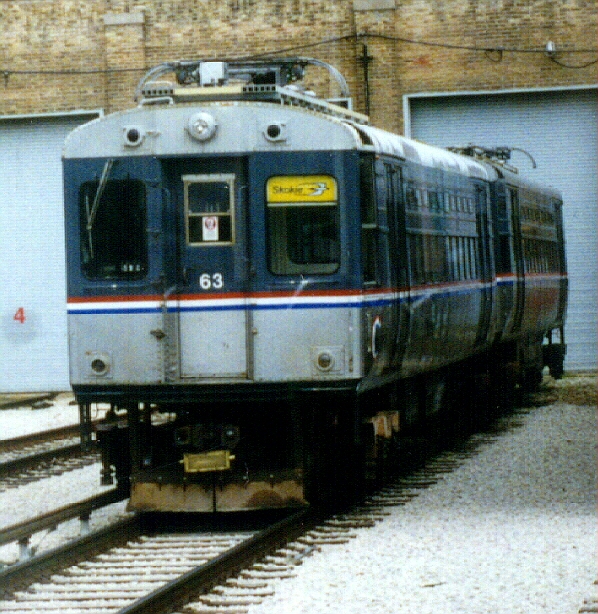
CTA 52 (Skokie Swift)

The underbodies of all three sections have been primed, leaving the bodies of the A and A1 sections of the car in their natural state. A resistance soldering unit was acquired from the defunct Chicago & Utopia shops and made short work of the trolley shrouds and brass roofboards. (I left the boards on one section for the time being as a reference point.)

Very recently, I ordered the Chopper III from NWSL and made short work of a set of styrene strips that will become the new roofboards. It is a very nice little tool that I expect to put to good use. I still have to get the dimensions of the “saddles” (the supports for the boards) and fabricate them before I can continue.

The PCC cars that were “Skokie equipped” were given sets of curved horns that I had long searched for as a commercially available product. This search was in vain. The 5000-series cars carried these horns on the roof near the destination/route sign meaning that they were generally out of reach. On a trip to the Illinois Railway Museum, however, I discovered that an accessible pair of 6000-series cars was equipped with these as well and that the horns were beneath the anticlimbers. Not long after returning with pen, paper, a tape measure, and a few other odds and ends, I had a set of 3D printed horns arriving at my office.

CTA 3200s (Skokie Swift)

After the last printing of the front section resulted in a less-than-optimal print (and also turned out that I’d made a mistake and made the piece too short) I have gone back and decided to redesign the whole thing (front and back). The rear portion looked good, however the brackets that support it didn’t fit into the grooves on the roof. This was something I had never intended and just figured I’d work around it, but with the needed redesign of the front, I figured why not correct this too? In all, it required an increase in width of 1mm. The difference is small enough that it shouldn’t be visually noticeable, but should prove to make the fit much better and easier.

After printing and priming a partition with closed cab door, I discovered that pipe filters would make an excellent filler for the cab door window. (The small window in the door has a crosshatch in it.)

Another advancement came with the announcement that NWSL had finally come out with the Stanton drive in O scale. The downside was that the wheelbases offered (8’-0”, 8’-6”, and 9’-0”) were too long for most traction applications, but after emailing them, I was informed that S scale drives were available that were capable of accepting O scale wheel sets and that the wheelbases offered (same as for O scale) would scale out appropriately for O scale traction applications. I promptly ordered a pair of these with a 9’ wheelbase with 30”/145 flush axle wheels. For the 1:45.2 size of the car, the trucks are slightly too short and the wheels are slightly too large, but this is by far close enough and well worth the avoidance of the headache of building my own. When complete, each car will have the rear truck powered so that the ends can have visually appropriate trailer trucks.

CNS&M 170 series cars (Shore Line train)

I make no attempt to hide the fact that I am a novice modeler from others or (more importantly) myself. Given that I recognized the simplicity of some of the North Shore cars and decided to put some effort on these.

Unlike the CA&E, there are no multiple unit connections needed for proper trolley operation and trailer cars only need power for interior lighting. With the completeness of the brass models, this reduces the project (for the most part) to painting and wiring (and the wiring will be simple due to its minimal nature). This made it a great starting point. I began priming one of the two models before remembering that the trolley hooks need to be removed and insulated for proper operation. The trolley hooks on these consist of a bent wire that runs through the boards and into the roof where it is secured in place. Unfortunately it was not secured with a bead of solder so it could not be removed by heating the area and pulling without damaging the hook. Instead it needed to be removed, which was done with a Dremel. (I’m short on parts for this, so this is as far as I’ve gotten.)

3D Printing

It came to my attention that Bestine, the solvent used to remove the waxy leftovers from the 3D printing process is no longer made. I didn’t hear about this in time to stockpile it before it was all gone. The search for a pure heptapane replacement is ongoing.

Layout

There has also been decent progress on the benchwork, which is almost complete. All that remains at this point is installation of the legs, shelf brackets, and the two storage shelves. (Sufficient funds and access to the proper tools are the two things holding this back at the moment.)

The section under construction is going to feature the North Side Main Line embankment as it passes through Edgewater. This is a four track structure with island stations. I toyed with the idea of throwing in some crossovers, but decided to leave it at four straight tracks and I’ve acquired the track and subroadbed for this.

I’ll endeavor to put forth more effort in both modeling and maintaining this blog in 2017!

Tuesday, September 29, 2015

Beginning on the 5000

Over the past few months I've been doing a bit of project hopping.

I stepped away from 3D modeling to do some “real” modeling. This has focused on the 5000 series Skokie Car. I’ve had this thing for several years and I finally started doing something with it. Prior to painting (which would be done best with an airbrush—a tool not currently within the Dunsel Line shops) the car needs to be primed.

Brass models often come with a protective coating so that they arrive in the eager hands of the modeler with a crisp, glossy luster. While this coating keeps the brass free of surface imperfections, it impedes the painting process and therefore needs to be removed.

My 5000 no longer had the glimmering brilliance it must have had when it was new and had developed a few tarnish spots in. As such, I wasn’t sure if the brass had the protective clear coat on it. Going the safe route, I “removed” it anyway. The method here was a breadbox filled with thinner. (I actually got this breadbox while on the IRM Highliner fundraiser. It’s officially traction related!) I started with the middle section as this requires no prep work, unlike the ends. The body and underbody/floor were soaked separately in the bath for 24 hours before being brushed off and cleaned. Interestingly, there was no gel coating left on the parts after the bath (as I was expecting) however there was a distinct color change in the thinner, so I’m left to assume that there was a coating on the brass.

Dis is what happens when you displeases da boss, see? You sleep wit da lacquer thinner fishes, chump!

Before I repeat this process with the ends, I need to remove the trolley pole shrouds and roof boards. This will require a soldering iron which will be acquired in the immediate future.

Once both pieces of the middle section were dry, they were primed with Tamiya light gray primer.

I also ordered the replacement wheels for the unpowered trucks. As delivered, these cars came with resilient wheels but by the time they were assigned to the Skokie Swift, these wheels had been replaced. (Since I need the car to be 2-rail operable, the wheels have to be insulated and therefore replaced anyway.) A quick search of Chicago-L.org shows that the 5000-series were equipped with 26” wheels so I acquired a set of 26” flush axle wheels from NorthWest Short Line.

I quickly installed them on the two trailer trucks and (aside from the faces needing to be painted silver) they look great. There is, however, one problem. The wheels supplied with the model aren’t the same size as the NorthWest Short Line wheels. They’re slightly larger, a difference which is only really noticeable when you have both sets in hand. The new, smaller wheels cause the truck to sit marginally lower. Unfortunately, this is just enough to cause the “hanging” track brake to rub against the rails. Other than switching to 28” wheels, I don’t have a solution at present.

A front truck with original wheels and tread-gap as seen under poor lighting conditions

A middle truck with replacement wheels and no tread-gap under the same poor lighting conditions

With an unusual bit of forethought on my part, shortly after buying the model, I ordered an interior kit from Q Car. The seats have all been cleaned and primed. I tested one seat with a can of Rustoleum chrome for the metal parts and I find it passable. Only this one seat has been done in this way since I haven’t been bothered to start the tedious process of masking all the other seats yet.

Friday, August 14, 2015

Pantographs and Trolley Beams

Strap in! It’s a long one.


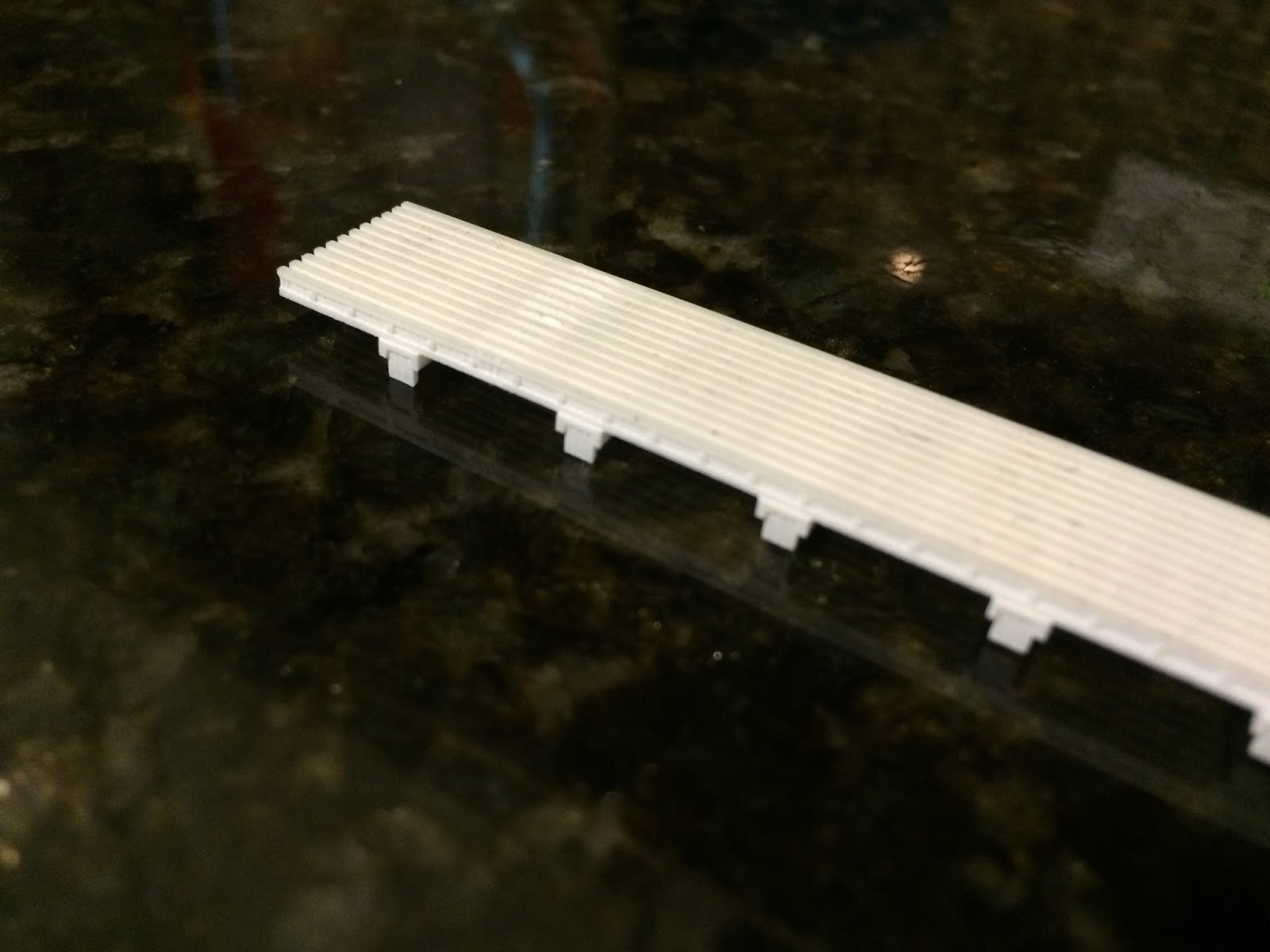
Since May I’ve made some headway on a number of projects. 3D modeling continues as always and on July 9, I received the first print of the experimental roof walks for the 3200 series cars. The walks in question are only the rear half, the portion that is only half-width. This was done as a cost saving measure for the test article.

The plan was to see how these came out and then work on and produce the front half which supported the pantograph. The two sections will line up and be glued together to form one complete piece. Instead of attempting to match the curve of the MTH roofs, I made the support brackets slightly longer than needed. Once glued together, I’ll place a piece of sandpaper on the roof and then gently rub the roof walks back and forth on top until they conform to the shape of the roof.

Unfortunately, after looking at the piece and being wholly satisfied with it, I began work on the forward portion only to discover that it would be visibly too wide for the car. To fix it, I needed to reduce the gaps between the horizontal members by 0.2mm each. Since the rear portion and the front portion have to line up, this meant that the rear portion needed to be narrowed as well, rendering the original one unusable.

I was able to make the rather tedious corrections relatively quickly and sent off for an updated version. Thankfully Shapeways was having a short term deal where shipping is free.

The narrowed rear portion of the roof walks arrived on the 16th and it definitely looks better than the original. The downside is that this was the first piece that I’ve gotten with some kind of a printing error. It arrived with a globule of “white stuff” which went across and between the slats in one section.

This didn’t come off while soaking in Bestine but did come off afterward after being cleaned with an old toothbrush under running water. Some of the slats were damaged (either in production or during cleaning—impossible to tell which) and from certain angles this shows. This end also has a strong odor of cherry syrup, which is highly unusual since 1) none of the other pieces have had this smell and 2) I can actually smell this with my barely functional nose! (The fact that I can smell it really attests to the strength of the smell.)

Otherwise, the piece came out well.

The damaged area is slightly visible from this angle. It is between the first and second supports on the left. In removing it, some of the top portion of the walk was damaged.

The original is at top. The newer one has been soaked in Bestine, giving a clear demonstration of what the agent does to Frosted Ultra Detail. Again, damage is visible here.

Tying in with the roof boards, my father and I took a trip out to the Illinois Railway Museum on Wednesday, July 8. While there, I was able to locate the pantographs from the 3200s and get some preliminary measurements. Now that I know where they are, I’ll be sure to acquire a very detailed set of measurements to be able to build the correct ones myself.

Progress has also been made on a new set of trolley beams for the same cars. I’m still working on perfecting the design of the third rail shoes themselves, but the equipment supporting the shoe has been designed and printed. This is a test to see how Frosted Ultra Detail handles separate-but-interlocking parts. (I would feel immensely satisfied if I could manage to produce dangling third rail shoes that could also glide on top of a rail.) If this fails, I can at least manufacture a set of trolley beams for the 3200s that don’t have provision for sleet scrapers on the rear trucks, as is prototypical.

The test piece also arrived on the same day as the narrowed roof walks. The two loops which hang down and connect to the third rail shoe do dangle, but not as freely as I’d hoped. Soaking them in a bath of Bestine did help, as did working them a bit, but they still don’t swing completely freely. I’m hoping there’s some kind of lubricant I can try to make them work better. I’d rather not resize the parts to improve “functionality” as areas on this piece are already pushing the limits of Frosted Ultra Detail in terms of minimum width and also because this would alter the look of the piece.

Perhaps it’ll work better once the shoe itself is added. Fingers crossed.

I actually printed this piece in Frosted Extreme Detail (which is the same material as FUD, but printed with thinner layers). The difference in cost for such a small piece ended up being 10¢ and I figured a dime was worth the expense of finding out what the big deal was.

Ultimately I don’t see too much of a difference and it certainly doesn’t seem to be worth the extra cost for larger pieces.


Additionally, I purchased a pair of Japanese pantographs from the East Gary Car Company. These pans are supposed to be junk, but as it’s the shoes I’m interested in, that doesn’t matter. I am fortunate enough to know someone who has a small, but overfilled workshop. He had a spare rotary tool (Ryobi, not Dremmel) that he didn’t want taking up space and he gave it to me. (One tool down that I don’t have to purchase!) Using this, I have already cut apart the shoes on one of the pans. (So far no complaints about the Ryobi.) These shoes (of which there will be four in total) will be for the 1-50 and 5000 series trolley pans. I still need to gather more information on the trolley pans before continuing much further down this road.

One of the big things holding me back on the 1-50 (car 2) and the 5000 (car 52) is my lack of a soldering iron. I’ll need this not only for the construction of the trolley pans, but also to remove the existing roof boards on both cars. I’m already stretching money a bit so this isn’t something I’ll be purchasing in the immediate future.

A tase of things to come

Still, progress continues. The middle section of car 52 doesn’t (and never did) have roof boards since there never was any trolley equipment located there. This makes the middle section an ideal place to start. I’ll prime this section as soon as possible.

The wheels on the 52 are another issue. As built, the 5000 series cars were equipped with resilient wheels. By the time the cars were assigned to the Skokie Swift and rebuilt, these wheels had been replaced with standard equipment.

The trucks supplied with the car are correct in appearance (they’re actually a fair sight better than the CTA 6000/1-50 Clark B3 trucks from Q Car) so I’ll be keeping these and replacing the resilient wheels currently on the model with “regular” 26” flush wheels from NorthWest Short Line. I haven’t decided on what to do with the power trucks yet. (I’m not even sure that the wheels are insulated. I have a strong doubt that they are.)

Tuesday, March 17, 2015

The March Meet

This past weekend was the weekend of the O Scale Meet (also known as the March Meet) and I was not going to miss it.

I arrived on Saturday, March 14, about an hour and a half after opening. I was delayed due to celebrating “pi day” by having a slice of pie at 9:26:53 a.m. (3/14/15 9:26:53—or 3.141592653—being the first ten digits of pi.) As always, I was on the hunt for more CA&E, North Shore, and “L” rolling stock and I was armed with a fat wad of twenty dollar bills in my pocket. As such, I was prepared to come and not find anything of particular interest.

Instead, almost immediately I was shown by a member of what my father has dubbed the "Trolley Mafia" to three brass North Shore models by MTS Imports. (I'm terrible with names and I've forgotten his. One of these days this will be the death of me.) Two of the models were early steel coaches from the 1920s with the double-width upper sash windows. As I've decided to model the North Shore circa 1952-1953, these were of no interest. The third was of an appropriate era and I decided to come back to it.

The traction selection was actually quite decent this year, although I did not see any "L" cars for sale. (I later discovered, much to my chagrin, that a pair of 1-50 series cars were sold the previous day—while I was at work.)

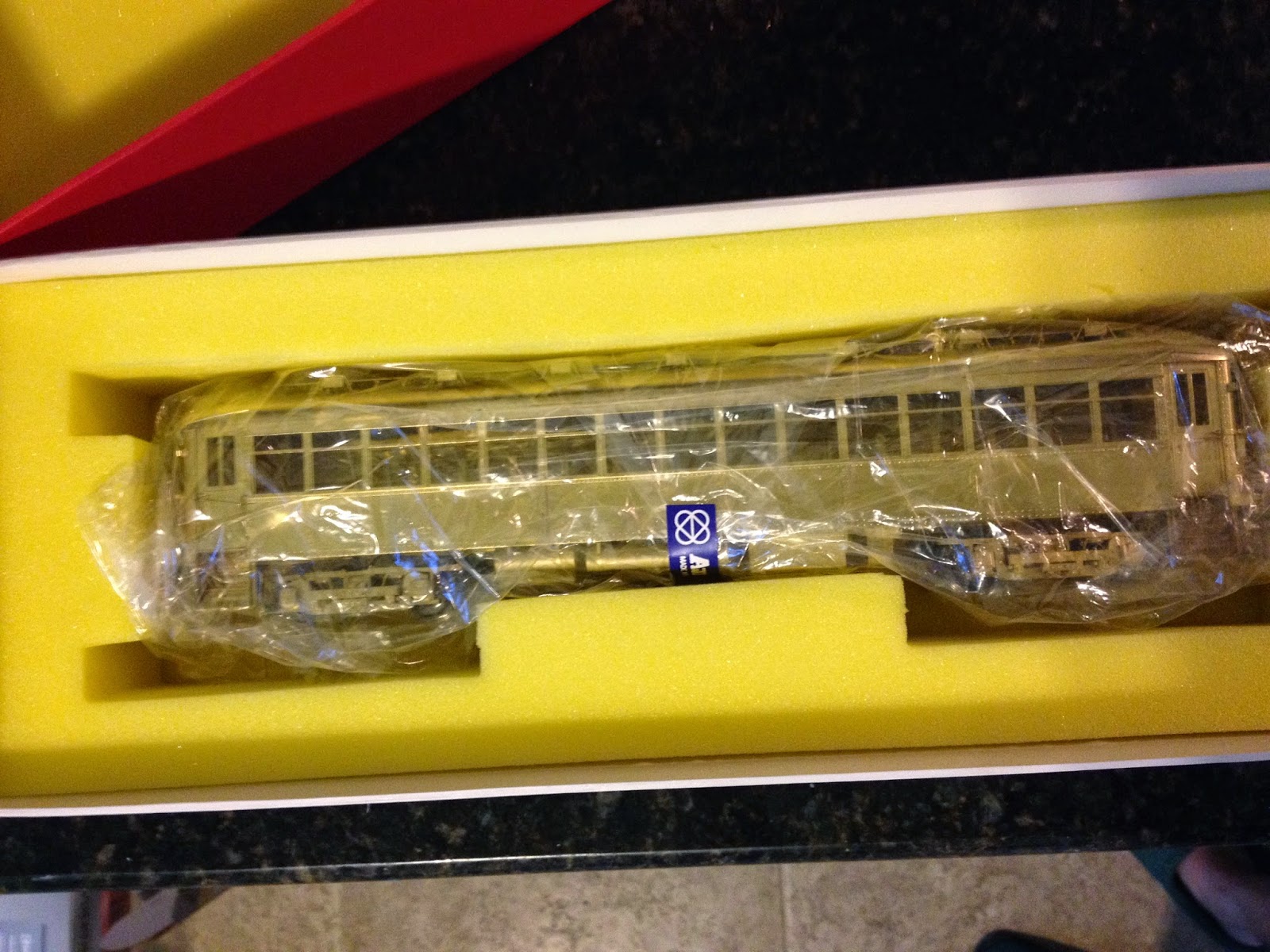
I did come across a pair of CA&E 450 series kits, another Clouser coach, and a North Shore wood (one of the ones that made it to the CA&E) but ultimately passed on these as my father already has four (unfinished) 450s and at least one North Shore wood. Instead I returned and purchased the third MTS Imports North Shore coach, a 170-182 series coach.

Still hasn't even been removed from the plastic wrap

I've decided that this car will be paired up with the Clouser coach I acquired last week as part of a Shore Line train. This car may remain unpowered, but whether I power it or not, I'll still have to replace the wheels for 2-rail operation. The Clouser coach and the high 700 will be part of a Skokie Valley train to Milwaukee. I am still waiting for the set of trucks (applicable for both of the latter cars) to arrive.

I also acquired a pair of pantographs for their shoes. And some CA&E trolley beams.

I got quite a bit of griping over the pantograph from my father. Something about "ruining" a pantograph just to get some parts. (For the record, the conscience of Dr. Frankenstein is undisturbed.) Besides, I later discovered that 1) the spring tension is rather weak (which would result in sub par wire contact) and 2) one of the pans is actually broken!

The shoe for this pantograph is a pretty close approximation for the shoes used on the CTA-designed pan-trolleys for the 1-50s and 5000 series assigned to the Skokie Swift. To use it for those two cars, the shoes on both pantographs would need to be removed and then the two halves (visually upper and lower in the image) sawed apart. Thus these two pans would yield the four pantograph shoes required for both models.

After leaving the meet, I attended the open house at Ed Halstead's Chicago & Utopia Railway. I didn't take any pictures, so unfortunately I don't have anything to show from the event. It was still a good time and several interesting models were run including a pair of early St. Petersburg Tram Collection Washington DC pre-PCCs and a South Shore coach. This was my first time seeing a model operating via pans and it helped me to visualize some of the operational differences of model pantographs versus trolley poles.

But enough talk. Time to get back to the shops and start working!

Tuesday, July 22, 2014

Project Overview: Skokie Swift

The primary focus of my efforts has been modeling equipment from the Skokie Swift. This project actually predates any conception of building a layout (or even doing anything in O scale) by several years. The idea first came to me while riding home from Columbia College on the Red Line in 2005.

Growing up in Southwestern Evanston I was always aware of the Skokie Swift. I did not ride the line much, though a trip with my father shortly after the arrival of the 3200-series in the early 1990s did have a lasting impact. Still, the Skokie Swift was always present, acting at the very least as a distant portion of the soundtrack to a quiet evening. The line and it's unique catanary operation stayed with me through high school and on into college.

I started attending Columbia College Chicago in October 2004. Once I had gotten back into the swing of riding the "L" but before I had developed any real enthusiasm for it, I became vaguely aware that the "Yellow Line" (the Skokie Swift) no longer used the overhead wire and that the pantographs would be removed sometime in the near future. I felt that this passing should be commemorated in some small way (by me) and, on a whim one spring day, drew a crude rendering of a pair of Skokie-equipped 3200-series cars intended to be operated on LGB track.

This little project simmered in the back of my mind for a few years. Eventually I got into traction modeling in O scale. MTH released a series of O gauge (3-rail) 3200-series cars and eventually I acquired a few of these. By this time I had decided on moving forward with the Skokie concept (but in O scale) and, as I learned about the history of the operation, expanded the scope a bit.

The Skokie Swift Project

In my expanded version of the project, I have decided to model four different "sets" of equipment used on the Swift: a 1-50 series, a 5000-series, a "60" pair, and, of course, a 3200-series pair.

1-50 series

Experimental high-speed cars 1-4 were the first equipment rebuilt and assigned to the Skokie Swift.

Several years ago the Dunsel Line acquired an unused CTA 1-50 series car from the Chicago & Utopia Ry (Ed Halstead of Modeling Insull's Empire). This car will have its roof boards removed and replaced and will be equipped with CTA-designed trolley pans.

This car was previously owned by the late Dave of Dave's Rail Pix who equipped with car with CA&E trolley beams and sleet scrapers.

5000-series (as 51-54)

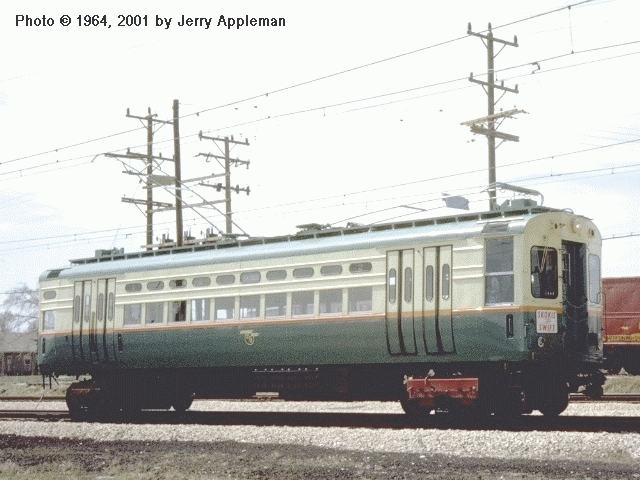
The second unit to be modeled is one of the most unique cars ever acquired by the rapid transit lines: the experimental 3-part articulated 5000-series cars. Like the 1-50, this car will also be equipped with trolley-pans. These four cars wandered the "L" system, not finding a permanent assignment due to some of the drawbacks of their design. They finally found a home on the Skokie Swift where their single unit, high capacity nature made them extremely useful. Once assigned, these cars remained in Skokie service for two decades before being retired.

61-65 series

The next set represented the first instance of a pair of cars being assigned to the line. In reality, the 60s were little more than pairs of rebuilt 5-50s that had been semi-permanently coupled and equipped with single-arm pantographs. I have yet to acquire a two more 1-50s, but I'm always looking.

3200-series

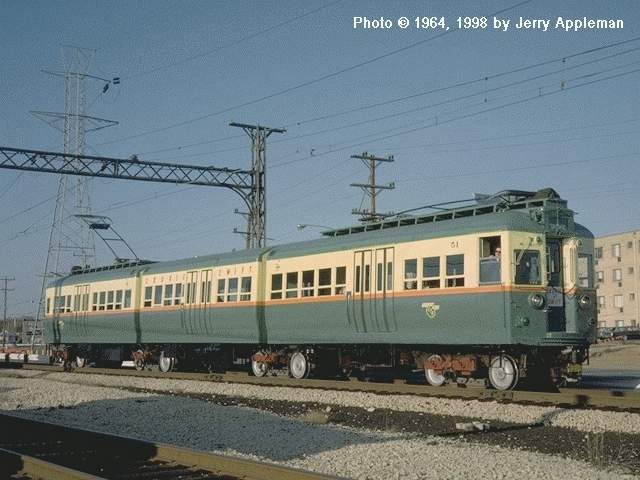
The 3200-series represents the last set of Skokie Equipment. These cars came equipped with pantographs for operation on the Swift.

For this, I'll be extensively rebuilding a pair of MTH 3200-series cars. The only downside here is that while the cars operate on O gauge track, they aren't O scale. MTH did a pretty good (not great, but far from terrible) job with the detail put into the cars, but unfortunately they didn't scale them properly for 1:48. Instead of being 12 inches long, the cars are 12 3/4 inches long from anticlimber to anciclimber. This is, however, fortunate as the cars are then the proper length for 17/64 (Q) scale, or approximately 1:45. This means they're correct for the track gauge.

The scale difference between the 3200s (left) and the other two cars (both O scale) is evident.

In addition to the addition of roof boards and pantographs, these cars will have to be entirely rebuilt from the floor down and be outfitted with new interiors.

Lots to do!