Showing posts with label 1-50 series. Show all posts

Tuesday, March 31, 2015

March in Review

Let’s get straight to the point; I spent a lot of money this month. Even though I’d planned on spending a good deal of money on models this month, my actual total greatly exceeds my anticipation (and this doesn’t even cover routine things like food and bills). I had a number of other projects (not model related) that also cost more than expected, so April will almost certainly be a very quiet month around here.

With that said, it seems like a good time to stop and reflect on a very expensive (but good) month. March is the month of the Chicago O Scale Meet (also known as the March Meet) and associated open houses at various trolley layouts. Preparation for these two prompted me to get back in gear and begin working on the 3D model of CTA’s form 5 coupler.

Ultimately this design wasn’t finalized in time for the open houses (I was only able to attend one) and the design work is still ongoing. The continuation of this project should be a nice one to carry on into April.

Before the meet I was able to get my hands on a Clouser North Shore steel coach. Although it did not come with trucks, I did get a good deal on it and am very happy with my purchase. The following week was the March Meet and there I bought a brass North Shore 170-182 series coach. Acquisition of this car has enabled me to outline and define my projects for the North Shore Line. I’d already decided on modeling the North Shore circa 1952/1953 (the same years for the CA&E) and the addition of these two older steel cars has led me to separate my efforts into the creation of two trains: Chicago-Milwaukee via Skokie Valley (the combine and upper 700) and a Chicago-Waukegan Shore Line train (the “older” coaches).

I have already ordered a motor truck set that would be applicable to either car on the Skokie Valley train, so I’m waiting for that to arrive. I’ll have to construct a test track pretty soon, which I suppose will be the very beginnings of my layout.

Also at the O Scale Meet I bought a pair of pantographs to turn into sausage. The shoes on these will be cut apart, to produce four “single” pantograph shoes. Each of these will be mounted at the end of a pair of four-spring horizontal trolley poles. I still need to buy a total of eight trolley poles for car 2 (the 1-50) and car 52 (the 5000) to make this. As a result of... overspending... I probably won’t begin this phase of that project in April.

After the March Meet I went back and made complete 3D models of the 3200-series snowplows. After increasing the size of the nuts so that they would register at Shapeways, these were sent off to the printer. They arrived on Monday and I am extremely pleased with the results. I’ve already made these available via the Ravenston Car Company at Shapeways. (Shameless self promotion!)

In continuing work on the 3200s, I ordered a set of wheels from NorthWest Short Line. I had planned on mounting these inside of cheap, temporary trucks (shop trucks) but I’ve abandoned this idea in favor of 3D printing my own set of “test trucks” which will enable me to try a few things out and see how well this will actually work. Unfortunately, 30” wheels are on backorder for about a month, so this particular project will probably have to wait for a while. In the meantime I’ll see if I can gather some pictures of the Duewag trucks with which the cars are equipped.

I know someone who claims (strong emphasis on “claims”) that he has access to equipment to make metal casts and, if all goes well, I should be able to make molds of the 3D prints and produce a series of metal trucks.

Even after the end of the March Meet March continued to be a money spender! I found another brass 1-50 series car and didn’t hesitate to grab it. To model the four basic iterations of Skokie Swift equipment as planned, I need a total of three of these cars: one as for a single-unit 1-50 and two for a double-unit 60. I now have two.

My first 1-50 has a dent on one end which I should be able to hammer and fill back into shape. Regardless of how well this turns out, the original (dented) 1-50 will now be used as part of the 60 pair with the dented face being positioned between the cars to minimize its visibility. The new car will now be the single and will get the CTA designed trolley-pans.

I also started work on a 3D model of the resistor grids for the 3200 series. This model uses measurements taken from the pair of 2400-series cars at the Illinois Railway Museum. There are subtle differences between the 2400 and 3200-series equipment that I have to account for and I’m currently working with the design to get it right.

The benefit of creating this model in full scale and then reducing it is that it can effectively be used to create specific models for the 2400, 2600, and 3200-series cars with only minor variations in each and scaled appropriately to 1:45 for the 3200s and to 1:48 for my planned 2400s and 2600s.

The 2200-series cars (which I have already started designing) used a resistor set that was substantially different than those used on the later cars. During my last trip out to IRM, I didn’t take underbody measurements for the 2200s, so I won’t be able to continue work on that particular set until I make another trip out to Union.

Finally (my wallet has its fingers crossed that this really is finally) I found a power truck set that would be appropriate for either car in the Skokie Valley train. It matches the truck I ordered from NorthWest Short Line, although at present I don’t know if the motors are Magic Carpet IIs or IIIs. The main impetus for getting this truck was the fact that I was able to get it for a substantially lower price than normal.

Moving forward into April my projects are most likely going to be all 3D modeling as this can be done at no cost. I plan to finish the form 5 coupler, work out the kinks with the resistors, and begin creation of an underbody set for a 2400-series pair (since I have photos and measurements on hand for that). I’ll also be continuing to fabricate the replacement car floor for the second 3200-series car.

Tuesday, March 17, 2015

The March Meet

This past weekend was the weekend of the O Scale Meet (also known as the March Meet) and I was not going to miss it.

I arrived on Saturday, March 14, about an hour and a half after opening. I was delayed due to celebrating “pi day” by having a slice of pie at 9:26:53 a.m. (3/14/15 9:26:53—or 3.141592653—being the first ten digits of pi.) As always, I was on the hunt for more CA&E, North Shore, and “L” rolling stock and I was armed with a fat wad of twenty dollar bills in my pocket. As such, I was prepared to come and not find anything of particular interest.

Instead, almost immediately I was shown by a member of what my father has dubbed the "Trolley Mafia" to three brass North Shore models by MTS Imports. (I'm terrible with names and I've forgotten his. One of these days this will be the death of me.) Two of the models were early steel coaches from the 1920s with the double-width upper sash windows. As I've decided to model the North Shore circa 1952-1953, these were of no interest. The third was of an appropriate era and I decided to come back to it.

The traction selection was actually quite decent this year, although I did not see any "L" cars for sale. (I later discovered, much to my chagrin, that a pair of 1-50 series cars were sold the previous day—while I was at work.)

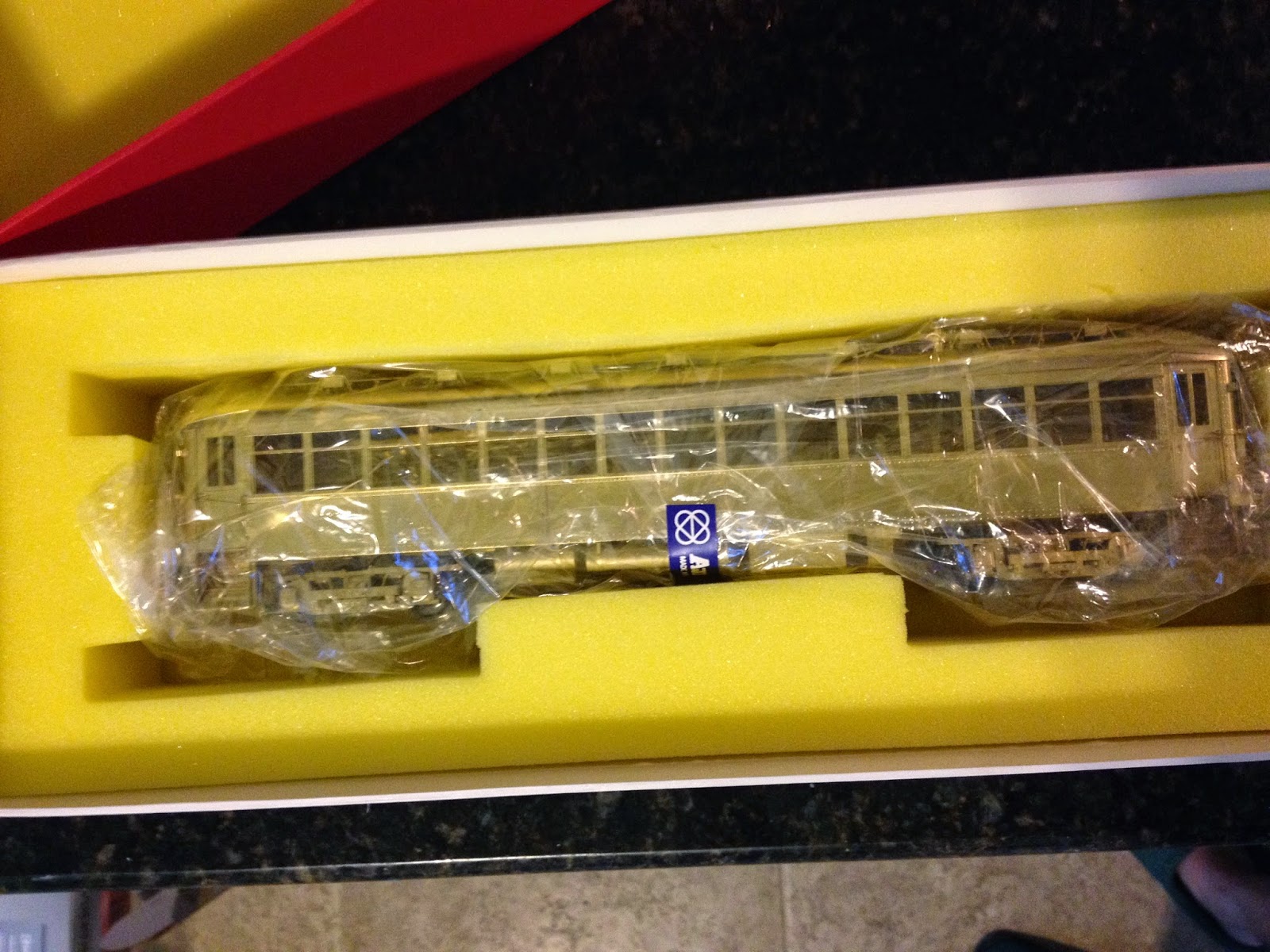
I did come across a pair of CA&E 450 series kits, another Clouser coach, and a North Shore wood (one of the ones that made it to the CA&E) but ultimately passed on these as my father already has four (unfinished) 450s and at least one North Shore wood. Instead I returned and purchased the third MTS Imports North Shore coach, a 170-182 series coach.

Still hasn't even been removed from the plastic wrap

I've decided that this car will be paired up with the Clouser coach I acquired last week as part of a Shore Line train. This car may remain unpowered, but whether I power it or not, I'll still have to replace the wheels for 2-rail operation. The Clouser coach and the high 700 will be part of a Skokie Valley train to Milwaukee. I am still waiting for the set of trucks (applicable for both of the latter cars) to arrive.

I also acquired a pair of pantographs for their shoes. And some CA&E trolley beams.

I got quite a bit of griping over the pantograph from my father. Something about "ruining" a pantograph just to get some parts. (For the record, the conscience of Dr. Frankenstein is undisturbed.) Besides, I later discovered that 1) the spring tension is rather weak (which would result in sub par wire contact) and 2) one of the pans is actually broken!

The shoe for this pantograph is a pretty close approximation for the shoes used on the CTA-designed pan-trolleys for the 1-50s and 5000 series assigned to the Skokie Swift. To use it for those two cars, the shoes on both pantographs would need to be removed and then the two halves (visually upper and lower in the image) sawed apart. Thus these two pans would yield the four pantograph shoes required for both models.

After leaving the meet, I attended the open house at Ed Halstead's Chicago & Utopia Railway. I didn't take any pictures, so unfortunately I don't have anything to show from the event. It was still a good time and several interesting models were run including a pair of early St. Petersburg Tram Collection Washington DC pre-PCCs and a South Shore coach. This was my first time seeing a model operating via pans and it helped me to visualize some of the operational differences of model pantographs versus trolley poles.

But enough talk. Time to get back to the shops and start working!

Tuesday, July 22, 2014

Project Overview: Skokie Swift

The primary focus of my efforts has been modeling equipment from the Skokie Swift. This project actually predates any conception of building a layout (or even doing anything in O scale) by several years. The idea first came to me while riding home from Columbia College on the Red Line in 2005.

Growing up in Southwestern Evanston I was always aware of the Skokie Swift. I did not ride the line much, though a trip with my father shortly after the arrival of the 3200-series in the early 1990s did have a lasting impact. Still, the Skokie Swift was always present, acting at the very least as a distant portion of the soundtrack to a quiet evening. The line and it's unique catanary operation stayed with me through high school and on into college.

I started attending Columbia College Chicago in October 2004. Once I had gotten back into the swing of riding the "L" but before I had developed any real enthusiasm for it, I became vaguely aware that the "Yellow Line" (the Skokie Swift) no longer used the overhead wire and that the pantographs would be removed sometime in the near future. I felt that this passing should be commemorated in some small way (by me) and, on a whim one spring day, drew a crude rendering of a pair of Skokie-equipped 3200-series cars intended to be operated on LGB track.

This little project simmered in the back of my mind for a few years. Eventually I got into traction modeling in O scale. MTH released a series of O gauge (3-rail) 3200-series cars and eventually I acquired a few of these. By this time I had decided on moving forward with the Skokie concept (but in O scale) and, as I learned about the history of the operation, expanded the scope a bit.

The Skokie Swift Project

In my expanded version of the project, I have decided to model four different "sets" of equipment used on the Swift: a 1-50 series, a 5000-series, a "60" pair, and, of course, a 3200-series pair.

1-50 series

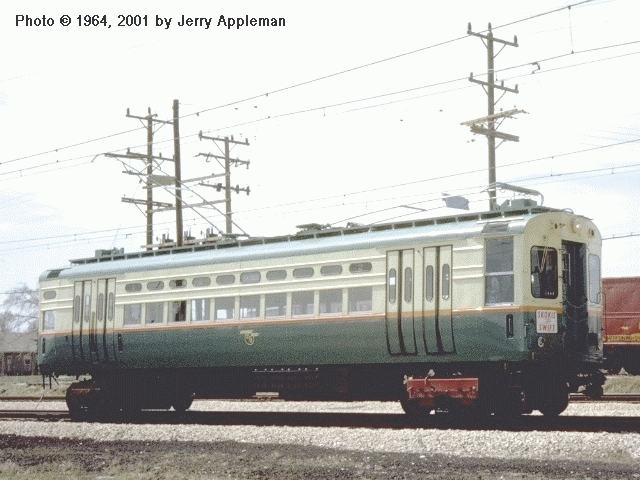
Experimental high-speed cars 1-4 were the first equipment rebuilt and assigned to the Skokie Swift.

Several years ago the Dunsel Line acquired an unused CTA 1-50 series car from the Chicago & Utopia Ry (Ed Halstead of Modeling Insull's Empire). This car will have its roof boards removed and replaced and will be equipped with CTA-designed trolley pans.

This car was previously owned by the late Dave of Dave's Rail Pix who equipped with car with CA&E trolley beams and sleet scrapers.

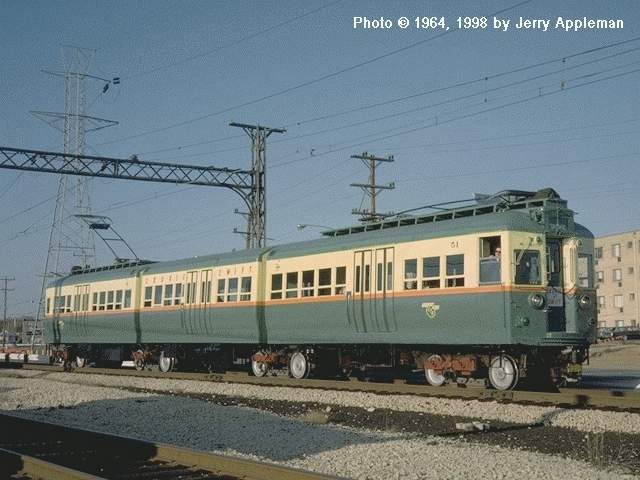
5000-series (as 51-54)

The second unit to be modeled is one of the most unique cars ever acquired by the rapid transit lines: the experimental 3-part articulated 5000-series cars. Like the 1-50, this car will also be equipped with trolley-pans. These four cars wandered the "L" system, not finding a permanent assignment due to some of the drawbacks of their design. They finally found a home on the Skokie Swift where their single unit, high capacity nature made them extremely useful. Once assigned, these cars remained in Skokie service for two decades before being retired.

61-65 series

The next set represented the first instance of a pair of cars being assigned to the line. In reality, the 60s were little more than pairs of rebuilt 5-50s that had been semi-permanently coupled and equipped with single-arm pantographs. I have yet to acquire a two more 1-50s, but I'm always looking.

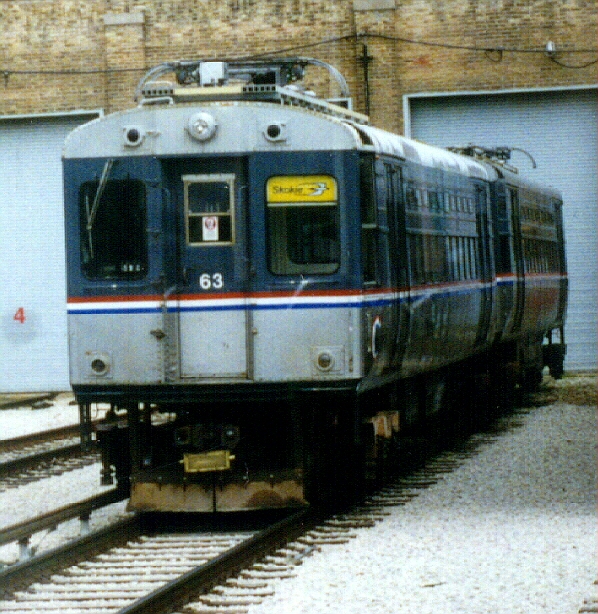
3200-series

The 3200-series represents the last set of Skokie Equipment. These cars came equipped with pantographs for operation on the Swift.

For this, I'll be extensively rebuilding a pair of MTH 3200-series cars. The only downside here is that while the cars operate on O gauge track, they aren't O scale. MTH did a pretty good (not great, but far from terrible) job with the detail put into the cars, but unfortunately they didn't scale them properly for 1:48. Instead of being 12 inches long, the cars are 12 3/4 inches long from anticlimber to anciclimber. This is, however, fortunate as the cars are then the proper length for 17/64 (Q) scale, or approximately 1:45. This means they're correct for the track gauge.

The scale difference between the 3200s (left) and the other two cars (both O scale) is evident.

In addition to the addition of roof boards and pantographs, these cars will have to be entirely rebuilt from the floor down and be outfitted with new interiors.

Lots to do!