Showing posts with label North Shore Line. Show all posts

Sunday, December 13, 2015

I Won't be Eating Any Time Soon

So I went to a model railroad/railroadiana show today with my father. This was a last minute affair and I had precisely zero expectation of finding anything of interest. For the most part the show lived up to my expectations, but toward the end I saw something and the more I looked, and the more I asked, the higher my interest became. I'll admit it: I actually became light-headed for a while. Then I walked away and finished the show. Upon completion, I promptly came back and bought it.

Now arriving at Adams & Wabash...

At this length, I won't be running her on the North Side embankment any time soon.

This is a two-rail Sunset Electroliner 803-804. (My father has the 801-802—and, as he pointed out, the substitute liner—so now we have a "complete set.") I don't think she was ever taken out of the box. Apparently, she garnered some attention at the show, but kept getting passed up because she isn't the three-rail version. So much the better.

She does have some problems. Almost all of the window glasses have fallen out or are on the verge of falling out. I knocked a few out myself when my fingers barely brushed up against them. The grab irons on one unit are also bent inward. Neither is a major issue. And for $600 I'm in absolutely no position to complain!

The window on the left is still in place, while the two on the right have fallen into the car.

Not a Pulitzer caliber photograph, but it will do to get the point across. The hazy lines running between window openings are the tops of the window glasses which have fallen out. The passenger seated here doesn't seem to have noticed.

The bent grabirons should be easily fixed by teasing them into place with a pair of needle-nose pliers.

Now I've got to get her set up for DCC and overhead operation.

Monday, October 19, 2015

Arches

I've been behind on updates since July and now I've got to try to catch up.

In addition to beginning work on the 5000, I also acquired new project. Back in October 2014, I purchased a set of Walthers North Shore ends on a whim. I had no plans for them and figured they might be useful down the road for trading or something. Later I was able to acquire a Walthers arched roof and mats. Again, purchased them only because they were available and decently inexpensive. (It should be obvious where this is going.) A few months ago I found a pair of Walthers “interurban sides” that were appropriate for a North Shore car. My new project is to assemble and complete this Walther’s North Shore kit. The car sides (specifically the window arrangement) put this car in the high 700s. I haven’t decided whether or not this car will be powered or even if it will be part of the Skokie Valley or Shore Line trains. It’s a low priority project; something for the backburner. In an email blast a while back, I saw a picture of a North Shore car built from a Walthers kit on the Salt Creek Lines. I’ve forgotten who built it, but it looked superb and betrayed nothing of its rather average beginnings. With the right amount of effort, I have high hopes that my planned car will look as good.

I've also done some 3D modeling. I went back and decided on a shape for the arches atop the support columns under the viaduct. I settled on useing a circle to create the curve of the arch although the shape of the actual arch is closer to a vertically squashed semicircle. The idea here is to make a mold of a 3D printed master since I’ll need fifteen middle columns and six end columns for the viaduct. I am yet to determine a method of actually doing this and I’ve also yet to select a material.

Circular arches. The green is simply a marker for how high the curb/sidewalks need to be and is not part of the model.

Once a suitable interior shape was developed to make the structure hollow (done to keep costs low[er]) I had it uploaded to Shapeways and printed. As soon as this went through, I suddenly realized a miraculously simple way of producing the "squashed semicircle" shape for the arches that I wanted. All that's required is drawing a circle and then rescaling it vertically, but not horizontally. The result is an oval.

"Squashed" arches. The difference is subtle, but the arches are a much closer match.

Meanwhile, the original design was printed and shipped out. The results were... less than optimal.

Looks okay so far.

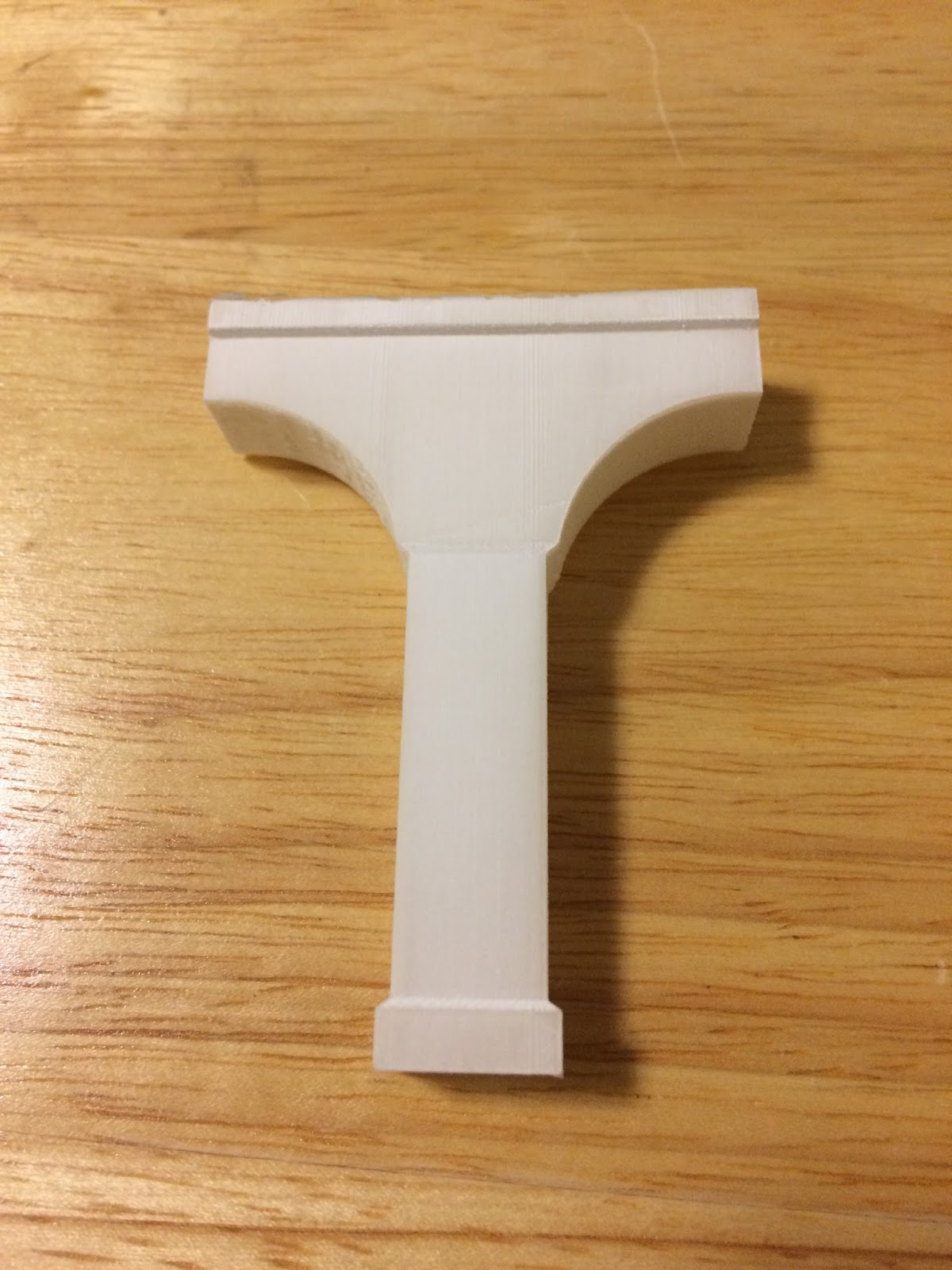
Oh. That's not right.

Not sure where the surface stuff came from, but that should be easily sanded off.

It's difficult to see, but the piece is actually slightly curled.

I'm actually not too worried about it since the arches need to be redone anyway.

Wednesday, June 24, 2015

Overdue update

After a long wait the, trucks for one of the Skokie Valley cars came in. (Both cars had the same trucks.) While I’m happy to have finally gotten these, they did not arrive without a small bit of frustration. The order was for a power truck with two Magic Carpets and a trailer truck. What I received was a pair of power trucks, each with one axle powered. I could alter the trucks to my original specifications, but I’ll probably just leave them as they are and go from there.

These are NorthWest Short Line Magic Carpet IIIs installed in Q Car Baldwin 8430AA sideframes. I opted not to get the sideframes with North Shore trolley beams so that I could devise and 3D print my own insane trolley beams with free hanging third rail shoes. If this fails, I'll acquire the appropriate Q Car trolley beams and attach them myself.

I took the opportunity of having a day off for Memorial Day to head out to the Illinois Railway Museum. They had (I believe) five trains in operation: a pair of CA&E woods, a pair of 4000 series “L” cars, the Zephyr, a steam train, and the CTA’s 2200 series cars. The 2200s were on town shuttle duty, operating on a short trip from 50th Avenue to Jefferson Street (the western end of the line) and back.

While I did take the opportunity to ride some trains, I was primarily there to complete and expand the measurements I took back in October.

In addition to more CA&E and North Shore equipment, one of the things I really want in O scale is a pair of 2400 series cars. Unfortunately, their numerous compound curves are fairly daunting and I haven’t yet conceived of a method to reproduce them properly.

Instead of attempting to tackle this task outright, I decided to try something “similar,” but with a much simpler design. The 2200 series, with its rectilinear forms and multitude of sharp angles was the clear and obvious choice. Drawings for the 2200 series were already available in CERA bulletin 115, Chicago’s Rapid Transit Volume II: Rolling Stock/1947-1976. I started with these drawings and then moved to taking field measurements at IRM. The plan was to do this at the end of the season in October and work on them over the winter, but the museum threw a monkey wrench into the works by moving the 22s away from the 50th Avenue station with its high-level platform. Here was the chance to rectify the situation.

I arrived on site around 9:30 and wasted no time in getting to business.

For the moment, the aim isn’t to produce a whole car. (That is, of course, the eventual goal.) I want to see how well I can produce a car side and then improve the design or (if satisfactory) continue the car to completion. To this end, my efforts were on filling in the missing measurements on the car sides and things couldn’t have gone more smoothly.

I have no idea what led me to believe that this would be a relatively simple “warm up” project. There are so many “minor” details which (if ignored) would end up drastically changing the shape—and therefore the look—of the model. Even without complete measurements, the car is definitely beginning to take shape.

Due to the costs involved, I’ll print a test “strip” to determine how well things are coming out and if there is anything that needs to be fixed. (Shapeways gave me a warning about the grill for the vent at the bottom of the car and I want to see how well this comes out before shelling out for the whole side.)

Ultimately the kit will be made of 5 parts per car, with the sides of the cars being produced as one long piece. Fortunately the car sides are just short enough in 1:48 that they barely meet the length limitation for Frosted Ultra Detail. As of right now, each side will cost just under $100 to make, but this doesn’t factor in the reduction in wall thickness at the doors or several other details that (when finished) will reduce the total material used.

I also got a few measurements for the Form 5 coupler. (I’d been having some difficulty with one particular area which I couldn’t get to look right.) With any luck I should be able to have a pair of 1:45.2 scale couplers for the 3200s rather soon. Once successful, O scale couplers will follow.

Tuesday, March 31, 2015

March in Review

Let’s get straight to the point; I spent a lot of money this month. Even though I’d planned on spending a good deal of money on models this month, my actual total greatly exceeds my anticipation (and this doesn’t even cover routine things like food and bills). I had a number of other projects (not model related) that also cost more than expected, so April will almost certainly be a very quiet month around here.

With that said, it seems like a good time to stop and reflect on a very expensive (but good) month. March is the month of the Chicago O Scale Meet (also known as the March Meet) and associated open houses at various trolley layouts. Preparation for these two prompted me to get back in gear and begin working on the 3D model of CTA’s form 5 coupler.

Ultimately this design wasn’t finalized in time for the open houses (I was only able to attend one) and the design work is still ongoing. The continuation of this project should be a nice one to carry on into April.

Before the meet I was able to get my hands on a Clouser North Shore steel coach. Although it did not come with trucks, I did get a good deal on it and am very happy with my purchase. The following week was the March Meet and there I bought a brass North Shore 170-182 series coach. Acquisition of this car has enabled me to outline and define my projects for the North Shore Line. I’d already decided on modeling the North Shore circa 1952/1953 (the same years for the CA&E) and the addition of these two older steel cars has led me to separate my efforts into the creation of two trains: Chicago-Milwaukee via Skokie Valley (the combine and upper 700) and a Chicago-Waukegan Shore Line train (the “older” coaches).

I have already ordered a motor truck set that would be applicable to either car on the Skokie Valley train, so I’m waiting for that to arrive. I’ll have to construct a test track pretty soon, which I suppose will be the very beginnings of my layout.

Also at the O Scale Meet I bought a pair of pantographs to turn into sausage. The shoes on these will be cut apart, to produce four “single” pantograph shoes. Each of these will be mounted at the end of a pair of four-spring horizontal trolley poles. I still need to buy a total of eight trolley poles for car 2 (the 1-50) and car 52 (the 5000) to make this. As a result of... overspending... I probably won’t begin this phase of that project in April.

After the March Meet I went back and made complete 3D models of the 3200-series snowplows. After increasing the size of the nuts so that they would register at Shapeways, these were sent off to the printer. They arrived on Monday and I am extremely pleased with the results. I’ve already made these available via the Ravenston Car Company at Shapeways. (Shameless self promotion!)

In continuing work on the 3200s, I ordered a set of wheels from NorthWest Short Line. I had planned on mounting these inside of cheap, temporary trucks (shop trucks) but I’ve abandoned this idea in favor of 3D printing my own set of “test trucks” which will enable me to try a few things out and see how well this will actually work. Unfortunately, 30” wheels are on backorder for about a month, so this particular project will probably have to wait for a while. In the meantime I’ll see if I can gather some pictures of the Duewag trucks with which the cars are equipped.

I know someone who claims (strong emphasis on “claims”) that he has access to equipment to make metal casts and, if all goes well, I should be able to make molds of the 3D prints and produce a series of metal trucks.

Even after the end of the March Meet March continued to be a money spender! I found another brass 1-50 series car and didn’t hesitate to grab it. To model the four basic iterations of Skokie Swift equipment as planned, I need a total of three of these cars: one as for a single-unit 1-50 and two for a double-unit 60. I now have two.

My first 1-50 has a dent on one end which I should be able to hammer and fill back into shape. Regardless of how well this turns out, the original (dented) 1-50 will now be used as part of the 60 pair with the dented face being positioned between the cars to minimize its visibility. The new car will now be the single and will get the CTA designed trolley-pans.

I also started work on a 3D model of the resistor grids for the 3200 series. This model uses measurements taken from the pair of 2400-series cars at the Illinois Railway Museum. There are subtle differences between the 2400 and 3200-series equipment that I have to account for and I’m currently working with the design to get it right.

The benefit of creating this model in full scale and then reducing it is that it can effectively be used to create specific models for the 2400, 2600, and 3200-series cars with only minor variations in each and scaled appropriately to 1:45 for the 3200s and to 1:48 for my planned 2400s and 2600s.

The 2200-series cars (which I have already started designing) used a resistor set that was substantially different than those used on the later cars. During my last trip out to IRM, I didn’t take underbody measurements for the 2200s, so I won’t be able to continue work on that particular set until I make another trip out to Union.

Finally (my wallet has its fingers crossed that this really is finally) I found a power truck set that would be appropriate for either car in the Skokie Valley train. It matches the truck I ordered from NorthWest Short Line, although at present I don’t know if the motors are Magic Carpet IIs or IIIs. The main impetus for getting this truck was the fact that I was able to get it for a substantially lower price than normal.

Moving forward into April my projects are most likely going to be all 3D modeling as this can be done at no cost. I plan to finish the form 5 coupler, work out the kinks with the resistors, and begin creation of an underbody set for a 2400-series pair (since I have photos and measurements on hand for that). I’ll also be continuing to fabricate the replacement car floor for the second 3200-series car.

Tuesday, March 17, 2015

The March Meet

This past weekend was the weekend of the O Scale Meet (also known as the March Meet) and I was not going to miss it.

I arrived on Saturday, March 14, about an hour and a half after opening. I was delayed due to celebrating “pi day” by having a slice of pie at 9:26:53 a.m. (3/14/15 9:26:53—or 3.141592653—being the first ten digits of pi.) As always, I was on the hunt for more CA&E, North Shore, and “L” rolling stock and I was armed with a fat wad of twenty dollar bills in my pocket. As such, I was prepared to come and not find anything of particular interest.

Instead, almost immediately I was shown by a member of what my father has dubbed the "Trolley Mafia" to three brass North Shore models by MTS Imports. (I'm terrible with names and I've forgotten his. One of these days this will be the death of me.) Two of the models were early steel coaches from the 1920s with the double-width upper sash windows. As I've decided to model the North Shore circa 1952-1953, these were of no interest. The third was of an appropriate era and I decided to come back to it.

The traction selection was actually quite decent this year, although I did not see any "L" cars for sale. (I later discovered, much to my chagrin, that a pair of 1-50 series cars were sold the previous day—while I was at work.)

I did come across a pair of CA&E 450 series kits, another Clouser coach, and a North Shore wood (one of the ones that made it to the CA&E) but ultimately passed on these as my father already has four (unfinished) 450s and at least one North Shore wood. Instead I returned and purchased the third MTS Imports North Shore coach, a 170-182 series coach.

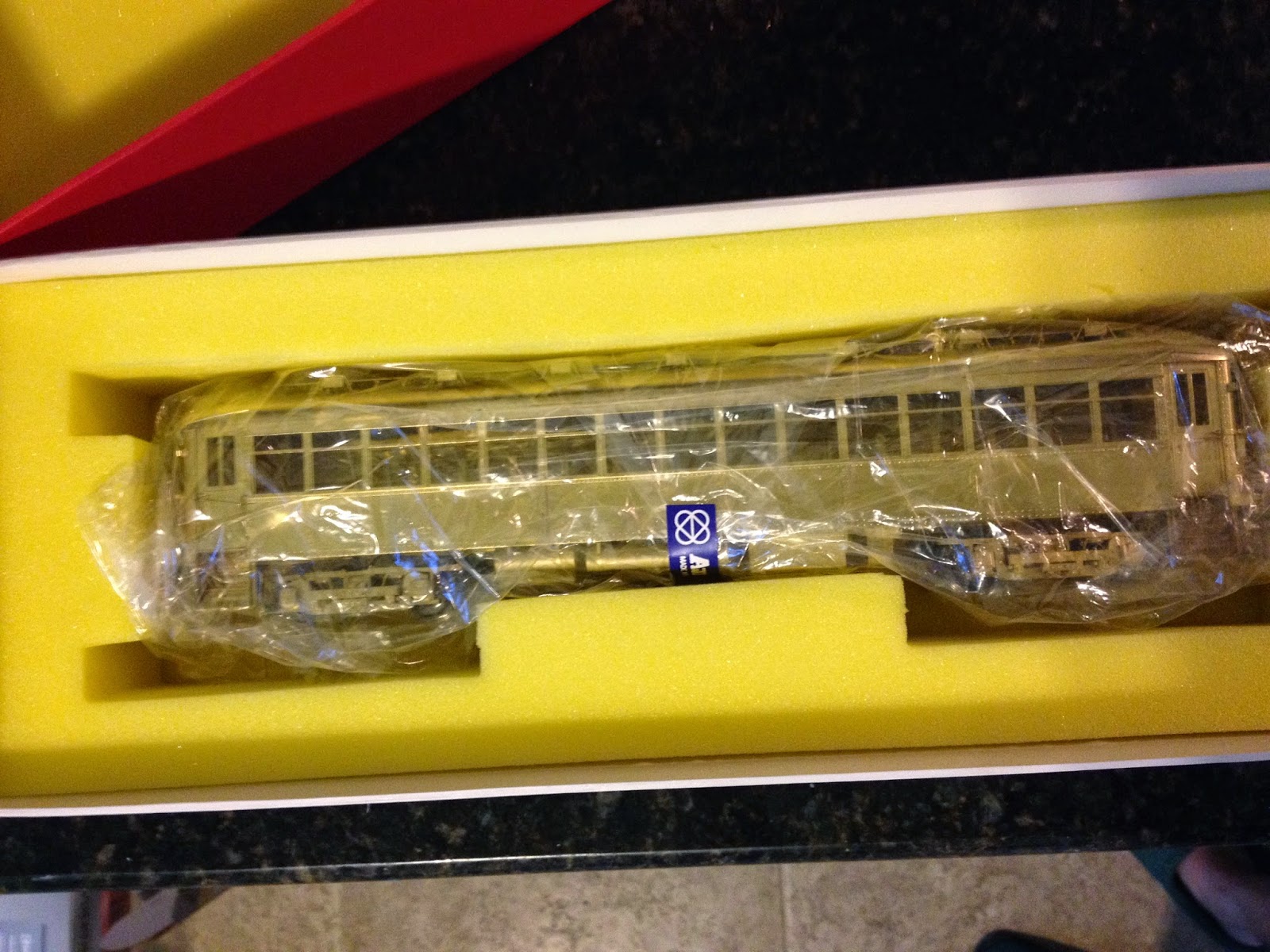
Still hasn't even been removed from the plastic wrap

I've decided that this car will be paired up with the Clouser coach I acquired last week as part of a Shore Line train. This car may remain unpowered, but whether I power it or not, I'll still have to replace the wheels for 2-rail operation. The Clouser coach and the high 700 will be part of a Skokie Valley train to Milwaukee. I am still waiting for the set of trucks (applicable for both of the latter cars) to arrive.

I also acquired a pair of pantographs for their shoes. And some CA&E trolley beams.

I got quite a bit of griping over the pantograph from my father. Something about "ruining" a pantograph just to get some parts. (For the record, the conscience of Dr. Frankenstein is undisturbed.) Besides, I later discovered that 1) the spring tension is rather weak (which would result in sub par wire contact) and 2) one of the pans is actually broken!

The shoe for this pantograph is a pretty close approximation for the shoes used on the CTA-designed pan-trolleys for the 1-50s and 5000 series assigned to the Skokie Swift. To use it for those two cars, the shoes on both pantographs would need to be removed and then the two halves (visually upper and lower in the image) sawed apart. Thus these two pans would yield the four pantograph shoes required for both models.

After leaving the meet, I attended the open house at Ed Halstead's Chicago & Utopia Railway. I didn't take any pictures, so unfortunately I don't have anything to show from the event. It was still a good time and several interesting models were run including a pair of early St. Petersburg Tram Collection Washington DC pre-PCCs and a South Shore coach. This was my first time seeing a model operating via pans and it helped me to visualize some of the operational differences of model pantographs versus trolley poles.

But enough talk. Time to get back to the shops and start working!

Wednesday, March 11, 2015

Clouser Coach

Things at home are a bit of a mess at the moment, and this is the primary reason why I didn't add any pictures to the last post. I've done a little cleaning and now have a bit of space to display my most recent acquisition for some photos.

Other than the model itself, this was the only thing in the box. It is a list of changes made to the design of the coach and combine models. The coach I purchased is of the later design, while the combine is of the earlier casts.

The rubber bands are prototypical.

One of the 2-56 screws that holds the floor to the rest of the model. On the older models, a threaded rod connected to the roof penetrated the floor and was held in place by a tiny nut.

The level of detail in the Clouser models is incredible, and the fact that his name is still a byword attests to that. That said I have noticed one error with the coach. There is one stack on the roof which (correct me if I'm wrong) I believe is/was connected to the hot water heating system in the car. From all the pictures I've viewed of the 150-164 and 165-169 series&mdsah;which were virtually identical—the stack on the model is on the opposite side of the roof from those on the prototypes. According to the CERA bulletin (either Interurban to Milwaukee or Route of the Electroliners, I forget which) cars 159, 160, and 164, and cars 165 and 167 were converted to electric heat, so removing the stack all together and modeling one of these five cars would fix that problem.

The stack in question and its (approximate) placement on the prototype.

Sunday, March 8, 2015

Another Acquisition

Unfortunately the form 5 coupler mentioned in the previous post will not be ready in time for the O scale meet. There are still some aspects of the design that need to be resolved before I am able to print them. Given the amount of time before the O scale meet and associated open houses, even if the design was finished this very instant, the prototype still wouldn’t arrive in time.

There is, however, some good news to report. I attended a swap meet held at the DuPage County Fair Grounds in Wheaton earlier today. Generally these things don’t yield much (if anything) for O scale traction and I came expecting this. Ten minutes into the show I came across a Clouser North Shore Line coach body and you better believe I didn’t pass it up!

I also came across a pair of Yellow Book MTH 3200 series "L" cars. I’m not a 3-rail collector, although I do have several sets of the MTH 3200 series cars (excluding the pair that I intend to 2-rail). The Yellow Book cars are signed for Midway and this matches my four-car set. I figured that if I’m able to get my hands on a pair of the 3200 “silver” bodies, I wouldn’t need to cut up my current pair and if I got these I’d have the option to run an eight car Midway train with car numbers that aren’t duplicates. So I got these too.

The main victory of the day, though, was that Clouser body. The car represents one of the early steel coaches, either the 150-164 series or the nearly identical 165-169 series. (I haven’t yet decided which series this car will fall into.) Unlike the combine I got from eBay, the coach did not come with any detail parts. Also of not is that the car is one of the later castings of the kit. The roof of the combine is removable via a pair of small nuts that are tightened beneath the floor. The coach has a removable floor which is held in place by eight 2-56 screws. These are much harder to lose and far easier to replace than the tiny nuts on the combine!

Looks like projects are beginning to stack up on the Dunsel Line!

Wednesday, October 8, 2014

Time to Slow Down?

I try to keep my eyes open for another 1-50 series "L" car or two so that I can move forward with my Skokie Swift set. I'm also constantly on the lookout for more CA&E rolling stock. And yet I don't find either of these, but I manage within three weeks to acquire two O scale North Shore Line cars. The new car arrived today.

It's a 250-256 series combine which was produced by Bill Clouser. The quality (which is a given) is exceptional. The body is missing equipment (it was made that way) but the model came with—as far as I can tell—a complete set of exterior detail pieces. The only thing it's missing are poles, motors, trucks, and an interior. I'll need to determine the general era of the car, given the ventilators on the roof.

A side-by-side comparison of the ends of the two cars.

The roof doesn't seem to come off. Neither does the car floor. I haven't tried too hard out of fear of damaging the model.

Something else also arrived today.

Yup. More North Shore stuff. This time a pair of Walthers North Shore car ends. Still in the packaging. The printed price is $1.95. That's not quite what I paid! Currently I have no plans for these, but, you never know. Definitely could be useful down the road.

Thursday, October 2, 2014

Now arriving on Track 4...

The North Shore car arrived last week. Here it is!

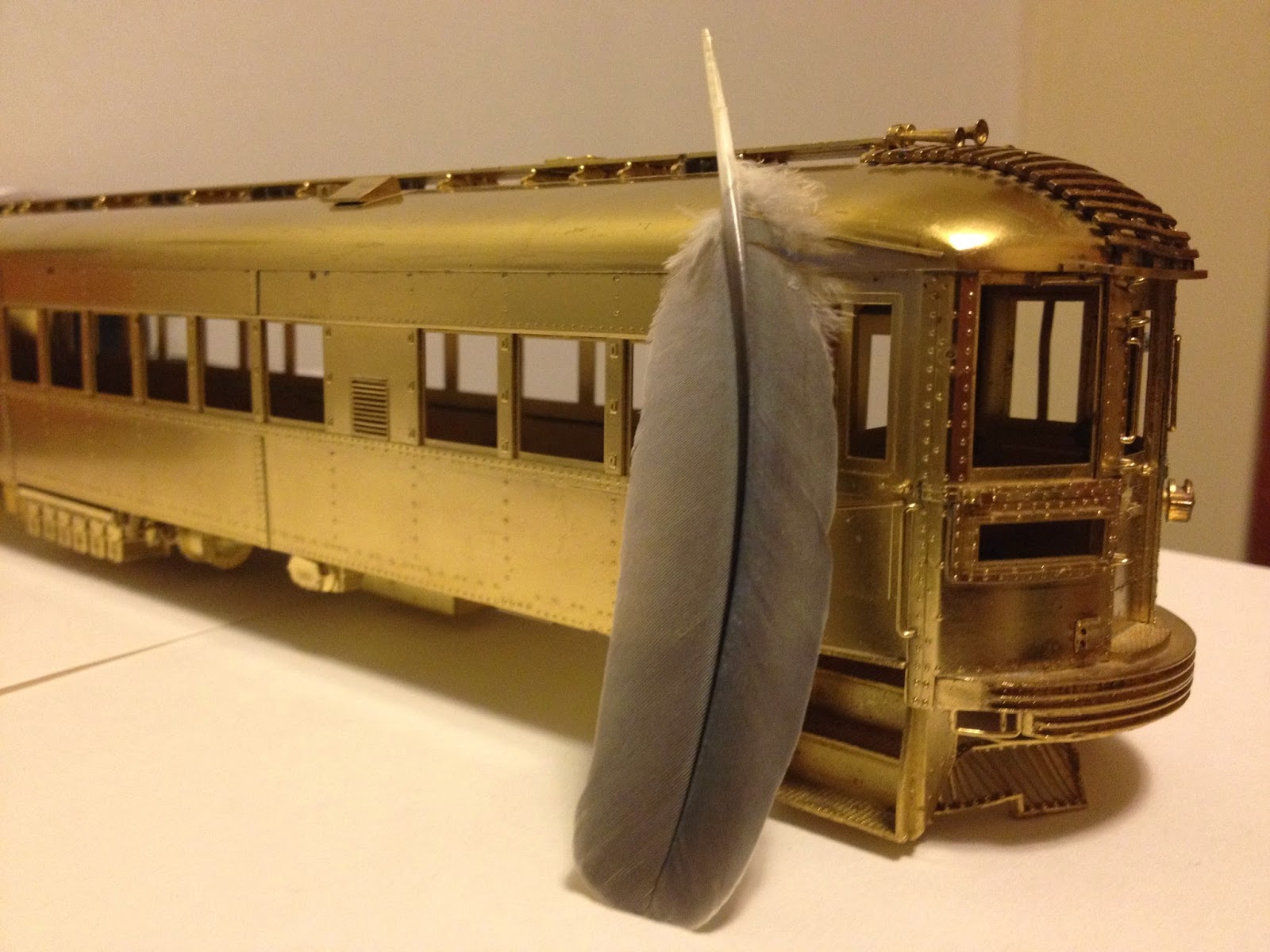
Despite its flaws—including a bent pilot—I'm quite satisfied. After reviewing the CERA bulletins, I've determined that this is a model of the 737-776 series of cars as modernized, but not as a Silverliner. These cars were actually from two separate series built by two different manufacturers at different times, but having almost identical specifications. 737-751 were built by Pullman in 1928. The rest were produced by Standard in 1930. I haven't picked a series yet (although I'm leaning toward the Standard-built cars) but I do know that I will not be giving it the number of a preserved car. I like the concept of recreating and preserving (in a small way—no pun intended) something that was lost.

The car is missing a few things. This includes (but is not limited to) trucks, couplers, poles, and trolley hooks. Also, on one corner a small bracket seems to have been knocked off. I believe this is supposed to hold either flags or lanterns. The more learned will have to comment.

The hole is where the missing bracket is supposed to be.

A little known fact about these cars is that while being modernized, the trucks and poles were removed. The cars were then painted in a rather striking all-brass livery. The area around the shops was also home to an American species of roc that was long believed to have been mythical. (The "legend" of these giant birds were the inspiration for Baby Huey.) The birds have since gone extinct, but I have managed to locate a rare color photograph depicting this situation. The Smithsonian will no doubt be interested in my finding.